Prelude — Humans Enter the Underwater World
For most of human history, the surface of the water was a border. Humans could swim across it, sail over it and take food from beneath it — but the world below remained somewhere we could visit only for a few breaths.
Then people began asking a stubborn question: How can we stay down there?
There was no single inventor of diving. Modern scuba is the result of thousands of years of breath-hold experience followed by advances in pumps, metallurgy, rubber, pressure regulation, physiology, warfare, salvage, science, filmmaking, offshore industry, exploration and recreation. The story belongs to sponge divers and engineers, frogmen and aquanauts, wreck hunters and scientists, commercial divers and weekend hobbyists.
This article follows those lines together. It also preserves famous diving stories even where archaeology cannot prove them, because legends, literature and films influenced the way generations imagined the underwater world.
1. Before History — The First Divers
Nobody can identify the first human who intentionally dived beneath the surface. Long before written records, coastal communities collected shellfish, food, pearls, sponges and useful materials underwater. Breath-hold diving is therefore not a side branch of diving history. It is the original form of human diving.
Traditional diving cultures later documented around the Mediterranean, Persian Gulf and Asia show how effective trained breath-hold workers could become. Mediterranean sponge divers, Persian Gulf pearl divers, Japanese Ama and Korean Haenyeo descended repeatedly, often using stones, baskets or ropes, and built livelihoods around underwater work.
2. Gilgamesh — A Diver in One of Humanity’s Oldest Stories
One of the oldest surviving literary works already contains an underwater descent. Near the end of the Epic of Gilgamesh, Gilgamesh learns of a plant associated with renewed youth. He binds heavy stones to his feet, is dragged down toward the deep, takes the plant, cuts away the stones and is cast back toward shore.
The description is strikingly familiar to a diver: weighted descent, a task at depth, release of the weights and ascent. It shows that deliberate descent into the underwater world was part of the human imagination more than three thousand years ago.
3. Antiquity — Working Divers, Warriors and Salvors
Classical sources describe skilled divers used for military and practical tasks. Herodotus tells the story of Scyllias, a celebrated Greek diver associated with naval warfare during the Persian Wars. Thucydides describes divers assisting military operations during the Peloponnesian War. Divers could cut obstacles, recover objects, inspect harbours or interfere with enemy ships.
Ancient diving was still breath-hold diving, but it was already specialized. A diver could be a harvester, courier, salvage worker or military specialist.
Alexander the Great and the Diving-Bell Legend
Later medieval and Renaissance manuscripts famously depict Alexander the Great descending beneath the sea in a transparent vessel or “glass barrel.” The story became one of the most enduring images in diving folklore.
4. Renaissance Ideas — Leonardo da Vinci and the Dream of Breathing Below
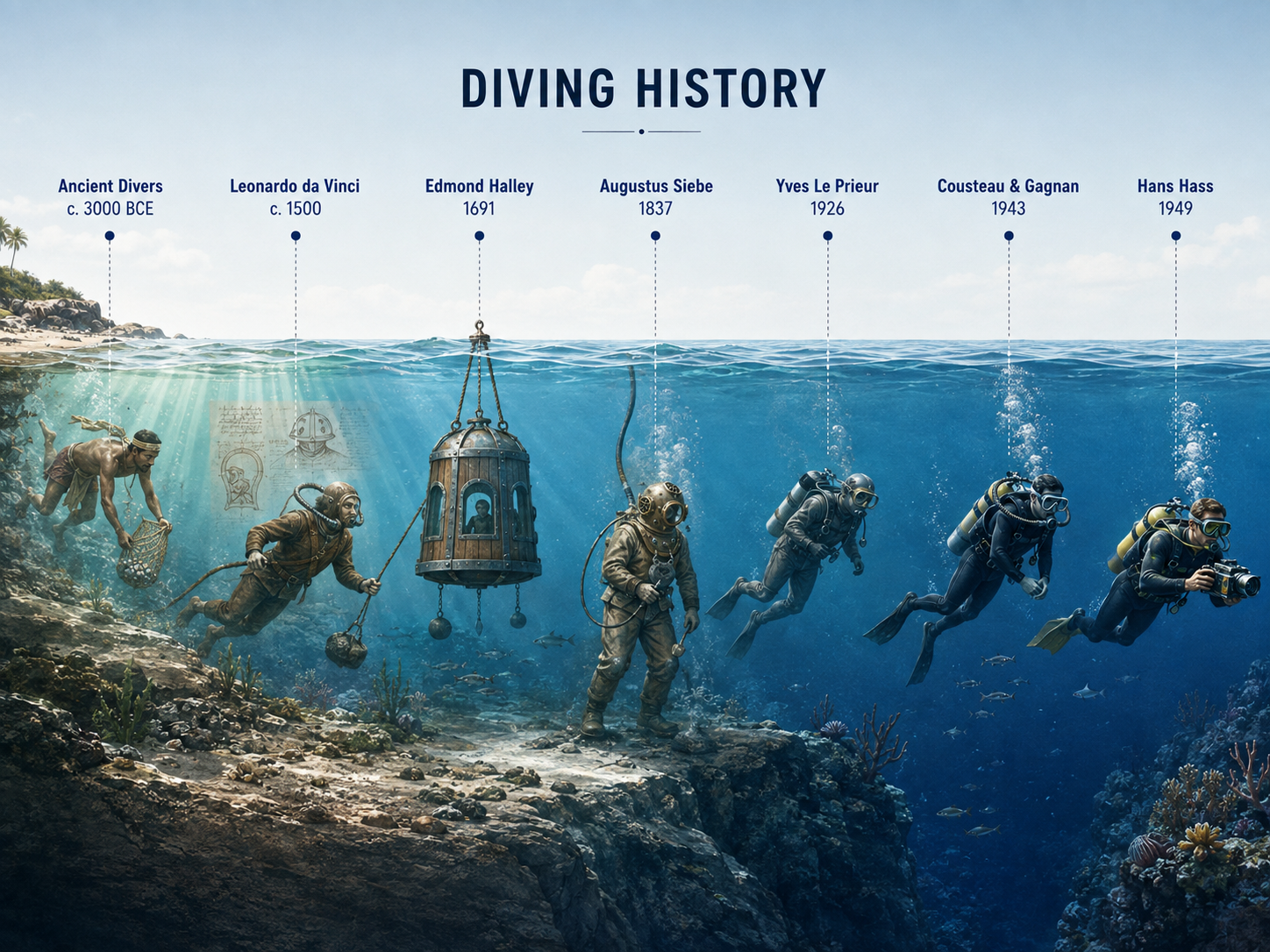
Leonardo da Vinci’s notebooks contain sketches and notes concerning underwater breathing, swimming, military attack and devices intended to allow a person to remain beneath the surface. Some concepts resemble breathing tubes, face coverings, air reservoirs or underwater tools.
Leonardo matters not because he can safely be called the inventor of scuba, but because he demonstrates a crucial transition: by the Renaissance, engineers were no longer only imagining underwater life in stories. They were attempting to design equipment for it.
5. The Diving Bell — Carrying an Atmosphere Downward
The diving bell solved the earliest endurance problem in a simple way: instead of carrying a breathing machine on the diver, take a pocket of surface air down with the diver. An inverted chamber traps air when submerged, creating a temporary underwater atmosphere.
By the seventeenth century increasingly practical bells were being used for underwater observation and salvage. Edmond Halley’s 1691 system used a bell replenished with containers of fresh air lowered from the surface. Bells greatly increased time underwater and helped establish salvage as a serious technical activity.
6. Early Wreck Salvage — Treasure Drives Technology
Long before recreational divers visited wrecks for history and adventure, wrecks represented wealth. Bronze cannon, precious metals, cargo and military equipment could justify extraordinary risks and investment.
Vasa — Salvage Beneath Seventeenth-Century Stockholm
The Swedish warship Vasa sank in 1628. During the 1660s, divers working with diving-bell technology recovered many of her valuable bronze cannon. The work showed that organized underwater salvage could be economically worthwhile even with very limited equipment.
William Phips and the Spanish Treasure Wreck
In 1687, William Phips led the spectacular recovery of treasure from a Spanish wreck in the Caribbean, traditionally identified as Nuestra Señora de la Concepción. The expedition returned a fortune in silver and made Phips famous.
7. The Industrial Revolution — The Working Diver Is Born
Industrialization supplied the technologies diving desperately needed: reliable pumps, machined valves, strong metals, improved hoses and rubberized fabrics.
The Deane Brothers
Charles and John Deane developed smoke helmets and then adapted the idea for underwater work. Their early diving helmet was supplied with air from the surface, but because it was initially an open helmet, the diver had to remain substantially upright to keep water from flooding inside.
Augustus Siebe and the Standard Diving Dress
During the 1830s Augustus Siebe improved helmet-diving equipment by connecting the helmet to a watertight suit. The closed standard diving dress allowed a surface-supplied diver to work with far greater security and mobility than earlier open-helmet systems.
For more than a century the image of the heavy copper helmet, canvas or rubberized suit, weighted boots and surface air hose became the universal symbol of the working diver.
8. Siebe Gorman — A Century of the Hard-Hat Diver
The company that grew from Siebe’s work became deeply associated with diving helmets, suits, pumps, breathing apparatus, submarine escape equipment and rebreathers. Siebe Gorman equipment served civilian industry, navies, salvage operations and rescue organizations across generations.
This reminds us that “diving equipment companies” were often not born from recreational sport. They grew from engineering, rescue, military and industrial requirements.
9. The Caisson — Pressure Disease Before Modern Diving Medicine
The nineteenth century created another underwater workplace: the compressed-air caisson. A caisson could form a dry working chamber below the water table. Compressed air kept water from entering while workers excavated foundations for bridges and other structures.
Charles-Jean Triger used compressed-air work chambers in the 1840s and described symptoms following pressure exposure. Later projects such as the Eads Bridge over the Mississippi and the Brooklyn Bridge exposed large groups of workers to substantial pressure. Men emerged with joint pain, neurological symptoms, paralysis and sometimes death.
The illness became widely known as caisson disease or “the bends.” These workers were not scuba divers, but their injuries became central to the birth of diving medicine because their bodies obeyed the same gas laws.
Paul Bert — The Gas Behind the Bends
French physiologist Paul Bert demonstrated that pressure alters how gases dissolve in the body and established nitrogen as the key inert gas involved in decompression illness. His experimental work helped transform mysterious caisson sickness into a physiological problem that could be studied.
10. William H. James — Carrying Compressed Air with the Diver
In 1825 William H. James patented an underwater breathing apparatus using compressed air carried by the diver. The system was primitive and should not be confused with practical twentieth-century scuba, but the core idea was unmistakable: the diver could carry a breathing-gas reservoir instead of depending completely on a surface hose.
James belongs in the long chain of attempts that eventually produced self-contained underwater breathing apparatus.
11. Rouquayrol and Denayrouze — The Demand-Regulator Line Begins
French mining engineer Benoît Rouquayrol developed pressure-regulating breathing equipment for hazardous mine atmospheres. Naval officer Auguste Denayrouze recognized its underwater potential, and during the 1860s the two developed diving equipment using a pressure reservoir and demand-regulation principle.
Their apparatus was not the compact sport scuba of the twentieth century, but conceptually it is one of the great ancestors of modern demand-regulated diving. Jules Verne later incorporated the Rouquayrol-Denayrouze idea into Twenty Thousand Leagues Under the Seas, helping merge real technology with the public imagination of underwater independence.
12. Fleuss and the Closed-Circuit Rebreather
In 1878 Henry Fleuss developed a practical closed-circuit oxygen breathing apparatus using chemical absorption to remove carbon dioxide from exhaled gas. The diver could recycle breathing gas rather than exhaust every breath into the water.
The fundamental closed-circuit equation remains recognizable today: remove carbon dioxide, replace metabolized oxygen and keep the breathing loop usable. Fleuss therefore represents the beginning of a rebreather branch that later ran through rescue equipment, submarine escape, military diving, scientific exploration and modern CCRs.
13. Dräger — Rescue, Submarines, Industry and Diving
Dräger became one of the most important names in breathing apparatus. Its work crossed mine rescue, firefighting, submarine escape, oxygen breathing systems, military diving and professional underwater equipment. Early twentieth-century portable diving and oxygen apparatus helped make self-contained breathing a practical tool in environments where a surface hose was impossible or undesirable.
Dräger would later intersect directly with Hans Hass and, decades afterward, with recreational semi-closed rebreathers such as the Atlantis/Dolphin and Ray. The company is a good example of how rescue and industrial technologies repeatedly migrated into diving.
14. Submarine Escape — The Davis Apparatus
The development of submarines created a terrible new problem: how could sailors escape a disabled boat resting below the surface? The Davis Submerged Escape Apparatus used an oxygen breathing system and counterlung to provide a portable life-support device for escape.
Submarine escape equipment and diving rebreathers share important technical ancestry. Equipment designed to save a sailor from a sinking submarine also helped advance compact underwater breathing technology.
15. Haldane — Making the Ascent a Science
By the beginning of the twentieth century, the central diving problem was no longer only “How do we get down?” or “How do we breathe?” It was “How do we come back safely?”
John Scott Haldane and colleagues developed staged decompression concepts for the Royal Navy in the early 1900s. Their compartment-based approach led to practical decompression tables and established the idea that ascent could be planned mathematically rather than left to intuition.
Haldane’s work became a foundation upon which later naval, scientific and recreational decompression systems were built.
16. Helium, Narcosis and the Deep-Diving Problem
As divers went deeper on compressed air, another limit became obvious. Nitrogen at high partial pressure causes narcosis, while gas density makes breathing increasingly difficult. Helium-oxygen mixtures offered a way to reduce narcosis and improve deep-diving performance.
U.S. Navy researchers including Albert Behnke contributed to the understanding of nitrogen narcosis and helium-based diving. Mixed-gas diving was initially an expensive naval and industrial technology, but many decades later its principles would move into technical sport diving as heliox and trimix.
17. USS Squalus — Rescue, Helium and Salvage in 1939
On 23 May 1939, the U.S. submarine USS Squalus sank during a test dive in roughly 240 feet of water. Thirty-three people survived in forward compartments while others died in the flooded after-section.
The McCann-Erickson Rescue Chamber was lowered to the submarine and made repeated trips, successfully bringing all 33 trapped survivors to the surface. The operation became a landmark in submarine rescue.
Then came the salvage. Deep work at Squalus helped demonstrate practical helium-oxygen diving. The wreck was eventually raised, rebuilt and returned to service as USS Sailfish.
18. Between the Wars — Masks, Fins, Spearfishing and Free Swimming
Between the world wars the silhouette of the diver began to change. The heavy helmeted worker remained essential, but lighter equipment encouraged another idea: the diver as an agile swimmer moving through the water rather than walking on the bottom.
Better rubber equipment, face masks, fins, compressed-gas cylinders and compact breathing apparatus made free-swimming diving increasingly practical. Spearfishing communities became important experimental laboratories because their divers wanted mobility rather than heavy surface-supplied equipment.
Yves Le Prieur
French naval officer Yves Le Prieur developed self-contained compressed-air diving equipment in the 1920s. His systems did not yet provide the efficient automatic demand regulation of the later Aqua-Lung, but they demonstrated the freedom of carrying compressed air on the diver.
19. Hans and Lotte Hass — Exploration Becomes Visible
Austrian pioneer Hans Hass belongs among the central figures of twentieth-century diving. Before modern recreational scuba had been established, Hass combined breath-hold diving, rebreathers, marine observation, photography, filmmaking and expedition science.
Working with Dräger and other collaborators, Hass helped develop and use free-swimming diving equipment and made underwater films that introduced audiences to sharks, reefs and the idea of the diver as explorer rather than merely worker.
Lotte Hass
Lotte Hass was not merely a companion to Hans. She became an accomplished diver, underwater performer, expedition participant and one of the most recognizable female faces in early underwater media. Her presence helped change the public image of who could be an underwater explorer.
Films including Pirsch unter Wasser, Menschen unter Haien, Abenteuer im Roten Meer and Unternehmen Xarifa placed underwater exploration in cinemas before television made Cousteau a global household name.
20. World War II — The Frogmen
World War II accelerated underwater technology with unusual intensity. Combat swimmers required stealth, range, navigation, breathing apparatus, explosives and delivery vehicles. Oxygen rebreathers were particularly attractive because they produced no exhaust bubbles, though their oxygen limits restricted depth.
Italy — Decima MAS and Human Torpedoes
Italian naval special units developed highly effective combat-swimmer operations using oxygen rebreathers and manned torpedo-like vehicles. Their attacks demonstrated that small underwater teams could threaten heavily protected harbours and capital ships.
Britain — Chariots and Special Operations
Britain developed its own swimmer-delivery systems, Chariots and specialist diving units, in part responding to Italian successes. British operations expanded the military use of self-contained underwater breathing and covert movement.
Germany — Kampfschwimmer and Small Combat Units
German special units also employed combat swimmers, rebreathers and small underwater craft during the later war years. Equipment and operational concepts varied, but the shared theme was the same: the diver had become an independent underwater soldier.
United States — UDT
U.S. Underwater Demolition Teams emerged during World War II for reconnaissance and obstacle clearance. Many operations relied heavily on breath-hold swimming, fins and masks because suitable scuba was not yet the universal tool it later became. UDT experience helped form part of the lineage that eventually led to modern U.S. Naval Special Warfare.
21. Cousteau, Dumas and Tailliez — The Mousquemers
The history of modern scuba is often simplified into a story about Jacques-Yves Cousteau alone. A fuller history includes Frédéric Dumas and Philippe Tailliez, Cousteau’s close diving partners — the famous “Mousquemers.”
Dumas brought extraordinary ability as a free swimmer and diver. Tailliez was a naval officer, instructor and underwater pioneer. Cousteau became the organizer, inventor, expedition leader, filmmaker and communicator whose influence reached the entire world.
22. 1943 — Cousteau, Gagnan and the Aqua-Lung
Engineer Émile Gagnan had experience with pressure regulators. Cousteau wanted a compact underwater breathing system that supplied gas only when the diver inhaled. Their collaboration produced the practical demand-regulated Aqua-Lung during 1943.
This did not represent the first idea of self-contained breathing. William James, Rouquayrol-Denayrouze, Fleuss, Le Prieur and others came earlier. What Cousteau and Gagnan achieved was a practical compressed-air demand system that could be manufactured, used by free-swimming divers and eventually popularized on an enormous scale.
23. Regulators — From Double Hose to the Modern First and Second Stage
The classic post-war Aqua-Lung placed the regulator mechanism behind the diver’s head and used two large corrugated breathing hoses: one for inhalation and one returning exhaled gas to the regulator body for discharge behind the diver.
It is important not to confuse hose layout with pressure-reduction stages. Some double-hose regulators were single-stage designs, while others were already two-stage. The famous CG-45 was a two-stage double-hose regulator. The later Mistral was a single-stage double-hose design. The U.S. Divers Aqua-Master combined a two-stage mechanism with the traditional two-hose breathing loop.
The Single-Hose Revolution
During the early 1950s several designers moved the demand valve to the diver’s mouth. E. R. Cross developed the Sport Diver in the United States, while Australian Ted Eldred independently developed the Porpoise. Other manufacturers followed.
The modern arrangement gradually became familiar: a first stage at the cylinder reduces high cylinder pressure to intermediate pressure, while the second stage at the diver’s mouth reduces it to ambient pressure on demand.
24. The Post-War Recreational Explosion — The Hobby Diver Appears
After the Second World War, military-surplus equipment, better rubber products, compressed-air cylinders, diving clubs, magazines and charismatic explorers helped turn diving into a civilian activity. What had been the domain of workers, navies and specialists increasingly became a hobby.
The 1950s and 1960s created the recognizable recreational diver: mask, fins, exposure suit, compressed-air cylinder, regulator and a small collection of instruments. Training organizations, dive shops and resorts gradually built the infrastructure that allowed ordinary people to learn.
25. From Mechanical Reserve to the SPG
Early recreational cylinders often used mechanical reserve valves. The best-known J-valve did not contain a separate emergency gas supply. Instead, a spring-loaded mechanism restricted gas flow when cylinder pressure fell to a preset level. The diver pulled a reserve rod to regain access to the remaining gas.
It was clever, but it depended on the reserve being correctly set and not accidentally pulled before the dive.
The Submersible Pressure Gauge Changes Gas Management
As reliable submersible pressure gauges became standard, divers could see cylinder pressure throughout the dive. The SPG shifted gas management from waiting for a mechanical warning to continuously knowing what remained.
26. Buoyancy Control — From No BC to Horse Collar, Jacket and Wing
Early free-swimming scuba divers often had no inflatable buoyancy compensator. They managed buoyancy through weighting, lung volume, swimming effort and exposure-suit characteristics.
Horse-Collar BCs
Inflatable flotation devices evolved into the familiar horse-collar buoyancy compensator worn around the neck and chest. These offered surface flotation and underwater buoyancy adjustment but could be bulky and unstable.
The Stabilizer Jacket and Modern BCD
Jacket-style buoyancy compensators integrated the air cell around the torso and became the dominant recreational design. Inflator hoses, over-pressure dump valves, integrated weights and improved harness systems followed.
Back-Inflate and Backplate/Wing
Technical and cave divers increasingly favored buoyancy behind the diver. Backplate-and-wing systems offered modularity, clean hose routing and good horizontal trim. Back-inflate concepts later spread widely into recreational equipment as well.
A simplified equipment line: no BC → horse collar → stabilizer jacket → modern jacket BCD → back-inflate → backplate and wing → specialist sidemount buoyancy systems.
27. The Recreational Diver’s Instruments
The early recreational diver might carry a depth gauge, watch and pressure gauge, then calculate decompression exposure using tables. Mechanical depth gauges and analogue instruments were simple, robust and required the diver to understand the plan.
Electronic dive computers gradually combined depth and time into continuous decompression calculations. Later generations added nitrox, multiple gases, trimix, digital compasses, air integration, rebreather setpoints, GPS-linked surface features and highly sophisticated displays.
28. Exposure Protection, Fins, Masks and the Everyday Diver
The everyday practicality of diving depended on many inventions that rarely receive the same attention as regulators. Rubber and neoprene exposure suits extended diving into colder water. Improved masks widened vision and made equalization practical. Modern fins converted leg motion into efficient propulsion.
The cumulative effect was enormous. A diver no longer needed to be a professional worker or exceptional athlete. Equipment became comfortable enough, reliable enough and standardized enough for millions of ordinary people to explore underwater.
29. Sea Hunt and the Television Diver
The television series Sea Hunt, broadcast from 1958 to 1961 and starring Lloyd Bridges as diver Mike Nelson, placed scuba equipment and underwater adventure in living rooms across North America and beyond.
The plots were fictional, but the imagery was powerful: cylinders, regulators, fins, knives, boats, underwater searches and rescues. For a generation, Sea Hunt helped turn scuba from an obscure activity into something people could imagine doing themselves.
30. Training Organizations — Diving Becomes a Worldwide Activity
As recreational diving expanded, clubs and training organizations transformed local instruction into recognizable certification systems. Different regions developed different traditions, and no single agency represents the entire history.
| Organization | Founded / era | Historical role |
|---|---|---|
| BSAC | 1953 | British club-based training tradition and major influence on sport diving. |
| CMAS | 1959 | World Underwater Federation; international federation tradition with strong European influence. |
| NAUI | 1960 | One of the early major international instructor-based recreational training organizations. |
| PADI | 1966 | Modular training and global growth helped make scuba a mass-participation activity. |
| SSI | 1970 | Retail- and training-center-linked international recreational training system. |
| DAN | 1980 | Diving medicine, emergency assistance, research and safety education. |
| IANTD | 1980s | Early formalization of nitrox, mixed-gas and technical training. |
| ANDI | 1988 | Early nitrox/technical education and SafeAir concept. |
| TDI | 1994 | Major technical-diving training organization; later paired with SDI recreational training. |
| GUE | 1998 | Team-oriented standardized technical/cave education and exploration culture. |
| NSS-CDS / NACD | 20th c. | Major cave-diving education and safety traditions in the United States. |
31. Diving Becomes Science
Scientific diving developed wherever researchers needed to observe, measure, sample and work directly underwater. Marine biology, geology, archaeology, physiology and oceanography all gained from the ability to put a trained human observer into the environment.
Scientific diving also encouraged formal procedures, project planning, specialized equipment, documentation and institutional safety systems. The scientific diver became another distinct branch of the larger diving family.
32. Beebe, Barton and the Deep-Ocean Submersible Line
Not every underwater frontier was reached by a diver swimming freely. In 1930 William Beebe and Otis Barton descended in the Bathysphere, a spherical pressure vessel lowered by cable from a ship. Their dives extended human observation far below practical ambient-pressure diving limits.
The bathysphere line eventually led toward bathyscaphes and modern submersibles. These vehicles belong beside diving in our history because they answered the same question in a different way: how can humans reach and observe a world where direct pressure exposure becomes impossible?
33. George Bond and the Saturation Idea
U.S. Navy physician Dr. George Bond became central to the development of saturation diving. His work explored the idea that after the body’s tissues have become saturated with inert gas at a given pressure, staying longer does not require proportionally more decompression.
This insight changed deep professional diving. Instead of decompressing after every work excursion, divers could live under pressure for days or weeks and complete one long decompression at the end of the saturation period.
34. Conshelf — Cousteau’s Underwater Houses
The 1960s were an extraordinary period when underwater habitation seemed like a plausible next frontier for humanity.
Conshelf I — 1962
Albert Falco and Claude Wesly lived for seven days in a small underwater habitat. The experiment tested whether humans could live and work continuously below the surface.
Conshelf II — 1963
The Red Sea “Starfish House” expanded the concept into a small underwater village, with aquanauts living at shallow depth and additional deeper stations used for experiments.
Conshelf III — 1965
Six men lived at approximately 100 metres depth for three weeks, demonstrating the remarkable possibilities — and complexity — of deep saturation habitation.
The Conshelf projects embodied a powerful 1960s dream: perhaps people would not merely visit the ocean but establish permanent communities beneath it.
35. SEALAB — The U.S. Navy Lives Underwater
The U.S. Navy’s SEALAB program explored saturation, physiology, engineering and underwater work at increasing depths. SEALAB I operated in 1964; SEALAB II followed in 1965 with longer missions and a larger habitat.
SEALAB III attempted a much deeper operation in 1969 but was terminated after diver Berry Cannon died during preparations. The tragedy ended the program, but SEALAB’s research strongly influenced saturation diving and underwater life-support practice.
36. Tektite — Scientists Become Aquanauts
Tektite I in 1969 placed four scientists underwater for 60 days. Unlike a purely naval or engineering experiment, the program emphasized scientific productivity during long underwater residence.
Tektite demonstrated that underwater habitation could be a research method, not merely a physiological experiment. It also helped normalize the term aquanaut for people living and working beneath the sea.
37. Aquarius — The Underwater Laboratory Survives
Aquarius Reef Base represents the surviving descendant of the underwater-habitat era. The habitat was first deployed in the U.S. Virgin Islands in the late 1980s and was moved to Conch Reef in the Florida Keys in 1993.
Aquarius has supported marine science, technology testing, education and astronaut analog missions. The underwater-colony dream did not disappear completely; it became a specialized scientific laboratory.
38. Saturation Diving — Living at Working Depth
Modern saturation diving is one of the most extraordinary forms of professional diving. Divers may live for weeks inside pressurized chambers aboard a vessel or platform. When required for work, they transfer under pressure into a closed diving bell, descend to the worksite, lock out into the sea, complete the task and return to the chamber without decompression.
At the end of the saturation period, the team undergoes one slow final decompression. Helium-based breathing mixtures, chamber systems, environmental control, communications and medical support make this possible.
Saturation is covered here because it represents a major human achievement in underwater endurance. The detailed industrial procedures belong to commercial-diving literature rather than this general scuba history.
39. COMEX and Henri Germain Delauze
French company COMEX, founded by Henri Germain Delauze, became synonymous with commercial deep-diving experimentation, saturation systems, mixed gases, hyperbaric research and offshore work. COMEX helped push human exposure to pressure far beyond ordinary sport-diving limits.
Its work sits between science and industry: experimental dives expanded physiological knowledge while offshore contracts demanded reliable systems that could function every day.
40. Offshore Oil and the North Sea — Diving as Heavy Industry
The expansion of offshore oil and gas during the 1960s and 1970s created enormous demand for underwater construction, inspection and repair. Divers worked on pipelines, platforms, valves, structures and subsea equipment in conditions far removed from the tropical image of recreational scuba.
The North Sea became famous for cold water, current, darkness, depth, helium atmospheres and heavy industrial tasks. Diving support vessels, closed bells, hot-water suits, chamber complexes and sophisticated communications evolved around this work.
Offshore diving remains important in our history because industry financed and operationalized technologies that later influenced technical, scientific and rescue diving. It should not, however, dominate a history aimed primarily at the broader diving community.
41. The Freediving Story — The Oldest Diving Becomes a Modern Sport
Freediving returns near the modern part of our story because the oldest form of diving developed into a highly technical sport of its own. Modern freedivers study equalization, hydrodynamics, physiology, relaxation, training and safety with a sophistication very different from simple recreational breath-hold swimming.
Important Names and Eras
Raimondo Bucher — Early post-war record diving and Mediterranean freediving culture.
Enzo Maiorca — Italian record diver whose rivalry and public profile helped define modern depth freediving.
Jacques Mayol — French freediver associated with deep relaxation, physiology and the cultural story later fictionalized in The Big Blue.
Umberto Pelizzari — One of the defining competitive freedivers of the 1990s and 2000s.
Francisco “Pipín” Ferreras — Prominent no-limits and deep freediver.
Audrey Mestre — Elite no-limits freediver whose death in 2002 became one of the sport’s defining safety tragedies.
Natalia Molchanova — Dominant competitive freediver, record holder and influential educator.
Herbert Nitsch — Multiple record-setting Austrian freediver associated with extreme depth.
William Trubridge — Major constant-weight/no-fins record diver.
Alexey Molchanov — Modern elite depth freediver and record holder.
Modern freediving also reconnects sport diving with traditional breath-hold cultures. The techniques, motivations and safety systems differ, but the underlying act — descending on a single breath — is the oldest diving method humans possess.
42. Wreck Diving — Underwater Time Machines
Wrecks changed meaning over the centuries. To the early salvor, a wreck was cargo and metal. To the modern diver it may be an archaeological site, war grave, historical mystery, technical challenge or all of these at once.
Improvements in navigation, decompression, mixed gas, DPVs, rebreathers, lights, cameras and mapping opened wrecks once considered unreachable to sport divers.
43. Andrea Doria — The Wreck That Helped Create Technical Wreck Diving
The Italian liner Andrea Doria sank off the northeastern United States in 1956. Divers were on the wreck almost immediately. Its depth, cold water, poor visibility, current, unstable structure and interior made it an exceptionally demanding destination.
For years many experienced wreck divers used deep air, accepting severe nitrogen narcosis and long decompression. Fatalities and accidents became part of the wreck’s reputation.
During the 1980s and early 1990s, oxygen decompression and helium-based mixed gas increasingly entered Northeast wreck diving. The Doria became a catalyst for changing what serious wreck divers considered acceptable equipment and gas planning.
The wreck therefore occupies a special place: not merely a famous shipwreck, but a practical laboratory in which technical wreck-diving methods evolved.
44. Cave Diving — Exploration Without Daylight
Caves created a different kind of problem. There may be no direct ascent to the surface, visibility can disappear instantly, passages can restrict movement, navigation depends on a guideline and gas must be reserved for the exit.
Cave divers gradually developed specialized principles: continuous guideline, redundant lights and gas, disciplined turn pressures, equipment streamlining, team procedures and controlled propulsion. Many ideas later associated with technical diving matured inside cave-diving communities.
45. Sheck Exley — Exploration Becomes Systematic
Sheck Exley became one of the most influential cave divers in history. His importance was not limited to depth and distance records. He analyzed accidents, promoted disciplined procedures and helped turn cave diving from adventurous improvisation into a systematic specialist discipline.
Exley’s exploration eventually included extreme deep cave diving and helium mixtures. His 1994 death while attempting a deep dive in Mexico also became part of the difficult history of pushing physiological and technological limits.
46. Wakulla — Cave Exploration Meets Advanced Technology
Wakulla Springs in Florida became a stage for several eras of cave exploration. The 1987 Wakulla Springs Project, associated strongly with Dr. Bill Stone and a large expedition team, tested experimental exploration equipment, advanced mapping methods and early Cis-Lunar rebreather technology.
A famous 24-hour underwater mission using an early Stone rebreather demonstrated how closed-circuit life support could radically alter exploration endurance. Later Wakulla projects added increasingly sophisticated mapping, propulsion, communications and robotic systems.
Wakulla is therefore not simply a cave-diving story. It links cave exploration, rebreather development, expedition engineering and digital mapping.
47. WKPP — Exploration Becomes a Team System
The Woodville Karst Plain Project developed a disciplined team approach to the enormous cave systems of north Florida. Divers including Bill Gavin, Bill Main, Parker Turner, Lamar English and others pushed distance while refining gas management, equipment configuration, decompression, DPV use and team procedures.
Dr. Bill Hamilton contributed decompression expertise to mixed-gas exploration. Scooters and staged gas allowed penetration distances that would have been impossible by swimming alone.
WKPP’s influence reached far beyond the caves themselves. It helped establish the idea that advanced exploration succeeds through standardized team systems rather than through isolated individual improvisation.
48. The Bahamas Blue Holes — Cave Diving Meets Multidisciplinary Science
The Bahamas contain extraordinary flooded caves and blue holes preserving geological, biological and archaeological records. In 2009 a major National Geographic-led project brought together explorers and scientists including Kenny Broad, Brian Kakuk and underwater filmmaker Wes Skiles.
The team conducted extensive dives across numerous blue holes, combining exploration with geology, biology, water chemistry, paleontology, archaeology and conservation. The caves preserved unusual ecosystems and ancient remains that could survive because of their isolated conditions.
This represents the modern explorer at his or her best: diver, mapper, photographer, scientist and conservationist working as one expedition team.
49. The Technical Diving Revolution
By the late 1980s and early 1990s, groups of experienced sport divers were combining methods previously associated with cave, commercial, military and scientific diving. They used decompression gases, nitrox, helium mixtures, doubles, stages, scooters, specialized buoyancy systems and increasingly rebreathers.
The practices existed before they had one accepted name. What changed was communication, training and community. “Technical diving” became the umbrella term for sport diving beyond conventional no-stop, depth and equipment limits.
Important figures included Sheck Exley, Tom Mount, Billy Deans, Dr. Bill Stone, Dr. Bill Hamilton, Michael Menduno and many cave and wreck divers whose practical experience shaped procedures. Organizations such as IANTD, ANDI, TDI and later GUE helped formalize education.
50. aquaCORPS and Immersed — When Technical Divers Started Talking
Technical diving needed more than new gas mixtures. It needed a way for scattered communities to exchange information.
aquaCORPS — 1990–1996
Michael Menduno launched aquaCORPS in 1990 because mainstream recreational publications were reluctant to discuss deep, decompression and mixed-gas sport diving. The magazine became a forum for decompression, nitrox, trimix, rebreathers, expedition techniques, accidents and emerging standards.
Menduno popularized the term “technical diving,” borrowing the idea from technical climbing. aquaCORPS and its associated Tek conferences helped turn previously isolated activity into a self-aware international movement.
Immersed
Bernie Chowdhury founded Immersed: The International Technical Diving Magazine in the mid-1990s. It continued serious reporting on wrecks, caves, mixed gas, equipment, exploration and safety after aquaCORPS had helped open the door.
Before internet forums and social media, specialist magazines mattered enormously. A wreck diver in the northeastern United States, a Florida cave diver and a European mixed-gas diver could suddenly learn from one another.
51. DPVs — Extending the Underwater Horizon
Diver Propulsion Vehicles changed the meaning of underwater range. Military swimmer-delivery vehicles and human torpedoes demonstrated the strategic value of powered underwater movement. Civilian scooters later gave cave, wreck and recreational divers the same fundamental advantage: distance without exhausting the diver.
By the 1970s scooters were already appearing in serious Florida cave exploration. Later technical teams built entire strategies around primary and backup DPVs, staged gas and rebreathers.
52. KCore Side Story — Bernd Böttger and the Escape Scooter
Not every underwater propulsion vehicle was built for exploration. During the Cold War, the guarded Baltic Sea represented one possible route out of East Germany.
Bernd Böttger secretly constructed a compact powered swimming device. In 1967 he planned to escape from the DDR across the Baltic, but the attempt was betrayed and he was arrested before entering the water.
After his release, Böttger built another improved device and in 1968 successfully escaped across the Baltic Sea to Denmark. His machine was not a recreational DPV in the modern sense, but it is a remarkable example of the same engineering idea — a swimmer using compact powered propulsion to extend underwater range — developed for an entirely different human purpose.
53. Sidemount — From Cave Tool to Worldwide Trend
Sidemount did not appear suddenly as a twenty-first-century recreational fashion. Its roots lie in cave and sump exploration where carrying cylinders beside the body allowed divers to pass restrictions, remove cylinders when necessary and adapt to awkward passages.
British sump divers and American cave divers developed different side-carried approaches. In Florida, Woody Jasper and other cave divers experimented with sidemount concepts, while Lamar Hires helped formalize and teach the configuration through the NSS-CDS during the 1980s.
During the 2000s, improved harnesses, dedicated wings and formal agency programs transformed sidemount from a specialist cave tool into a worldwide technical and recreational configuration.
54. New Ways to Dive — Configuration as Evolution
Diving equipment does not evolve in a simple line where one correct configuration replaces the previous one. Divers rearrange equipment to solve different problems.
A broad configuration timeline might read: standard diving dress → twin-hose scuba → single-cylinder sport rig → horse-collar and jacket BCD → doubles and manifold systems → backplate/wing and Hogarthian concepts → team-standardized technical systems → sidemount → modern CCR configurations → DPV-assisted exploration.
Some old ideas also return. Double-hose regulator concepts, wings, small rebreathers and chest-mounted systems reappear when modern divers discover that an older layout still solves a particular problem elegantly.
55. Modern Rebreather Exploration — Quietly Extending Range
Rebreathers never disappeared, but they remained specialized for much of the twentieth century. Military oxygen units, scientific systems and experimental mixed-gas machines continued to develop while open-circuit scuba dominated recreation.
From the late twentieth century onward, systems associated with Cis-Lunar, AP Diving and many later manufacturers brought electronically monitored closed-circuit diving into technical exploration. CCRs reduced open-circuit gas consumption, allowed more constant oxygen partial pressure and greatly increased practical range for deep wreck, cave and expedition diving.
In this article the rebreather remains an enabling technology rather than the main subject. Its complete technical history is treated separately by DiverInterCom KCore.
56. Sonar, Digital Mapping and Photogrammetry
The earliest explorer returned with a story. Later divers returned with sketches. Cameras added photographs and film. Modern teams can now return with measurable digital models.
Sonar
Sonar allows divers, vessels and robotic systems to locate and image structures in darkness, poor visibility or large search areas. Side-scan sonar, multibeam systems and imaging sonar transformed wreck discovery, cave surveying and underwater archaeology.
Photogrammetry
Photogrammetry reconstructs three-dimensional geometry from many overlapping photographs. A diver can document a wreck, reef, archaeological site or cave feature and later create an accurate digital model that can be measured, studied and revisited on a computer.
The modern exploration team increasingly combines divers with ROVs, sonar, digital survey, photogrammetry and geographic data. Exploration is no longer only reaching the site. It is preserving the site as information.
57. Women Who Changed Diving
Women were part of underwater exploration long before modern scuba, from traditional Ama and Haenyeo divers to scientists, filmmakers, instructors and record divers. A complete history cannot treat them as an appendix.
Lotte Hass — Early underwater diver, expedition participant and media figure whose work helped bring diving to international audiences.
Zale Parry — Pioneering American scuba diver, instructor, underwater performer and important public figure during the Sea Hunt era.
Dottie Frazier — Early female instructor, equipment maker and pioneering American sport diver.
Eugenie Clark — Marine biologist whose shark research and field diving changed public understanding of marine life.
Sylvia Earle — Marine biologist, aquanaut, deep-ocean explorer and major conservation voice.
Valerie Taylor — Australian diver, filmmaker and shark advocate whose work shaped public perceptions of marine wildlife.
Anne Doubilet — Underwater photographer and expedition diver associated with major magazine and exploration work.
Jill Heinerth — Modern cave diver, explorer, filmmaker and educator with major contributions to cave, rebreather and expedition diving.
Natalia Molchanova — Record-setting freediver and influential teacher whose achievements transformed competitive freediving.
58. Movies and Books That Made Divers
Diving technology gave people the ability to enter the underwater world. Storytelling made millions want to follow. Books, cinema and television are therefore part of diving history, not merely entertainment surrounding it.
| Year | Film / book | Why it matters |
|---|---|---|
| 1870 | Twenty Thousand Leagues Under the Seas — Jules Verne | Real pressure-regulator concepts blended with the fictional Nautilus and Captain Nemo. |
| 1940 | Pirsch unter Wasser — Hans Hass | Early underwater filmmaking before the post-war scuba boom. |
| 1942 | Menschen unter Haien — Hans Hass | Helped establish the diver-explorer and shark film tradition. |
| 1950 | Abenteuer im Roten Meer — Hans Hass | Major post-war underwater adventure film. |
| 1954 | 20,000 Leagues Under the Sea — Disney | Spectacular cinema brought diving suits, submarine adventure and Nemo to a mass audience. |
| 1956 | The Silent World — Cousteau / Louis Malle | Colour underwater cinema, Cannes Palme d’Or and Academy Award; enormous cultural impact. |
| 1958–1961 | Sea Hunt | Weekly television made scuba equipment and underwater adventure familiar to millions. |
| 1964 | World Without Sun | Cousteau’s Conshelf world and underwater habitation brought to cinema. |
| 1965 | Thunderball | One of cinema’s most famous mass underwater-action sequences. |
| 1977 | The Deep | Wreck diving, treasure and danger became popular cinema. |
| 1988 | The Big Blue | Fictionalized the Maiorca/Mayol freediving world and became a cult diving film. |
| 1989 | The Abyss | Commercial and saturation-diving imagery merged with science fiction. |
| 1994 | Into the Deep — Howard Hall | Landmark giant-screen underwater 3D filmmaking. |
| 2000 | Men of Honor | Popularized the story and culture of U.S. Navy hard-hat diving. |
| 2003 | Coral Reef Adventure | Howard and Michele Hall helped bring reef exploration and conservation to IMAX audiences. |
| 2004 | Shadow Divers — Robert Kurson | Brought the U-869 wreck-identification story and Northeast technical wreck culture to a global readership. |
| 2006 | Deep Sea 3D — Howard Hall | Major modern underwater IMAX production. |
| 2009 | Under the Sea 3D — Howard Hall | Continued the giant-screen underwater natural-history tradition. |
59. Howard and Michele Hall — The IMAX Generation
Howard and Michele Hall represent a modern continuation of the Hass and Cousteau tradition: divers who are also filmmakers, expedition organizers and interpreters of the underwater world.
Coral Reef Adventure was released in 2003 after expeditions to Fiji, French Polynesia and the Great Barrier Reef. Howard served as underwater sequence director, Michele as line producer, and both appeared in the film. The production linked spectacular IMAX imagery with reef science and conservation.
Howard Hall’s filmography also includes Into the Deep, Deep Sea 3D and Under the Sea 3D. These films brought enormous, high-resolution underwater images to audiences who might never wear a regulator themselves.
60. Modern Wreck Explorers — History Can Be Solved Underwater
Modern wreck diving has produced explorers who do more than visit known sites. They identify unknown wrecks, reconstruct sinkings and work with historians, families and archives.
John Chatterton and Richie Kohler — U-869
The discovery of an unidentified German submarine off New Jersey led to years of difficult diving and historical investigation. John Chatterton, Richie Kohler and fellow divers ultimately established the wreck as U-869, changing the accepted historical account of the submarine’s loss.
The story, later made famous by Shadow Divers, demonstrates an important change in the role of the diver: underwater evidence can correct the written historical record.
61. Modern Cave and Exploration Divers
No short list can represent the entire modern exploration community, but some names illustrate how diverse the field has become: Bill Stone in expedition engineering and CCR development; Wes Skiles in cave exploration and photography; Brian Kakuk in Bahamas cave exploration; Jill Heinerth in cave, rebreather and expedition work; Richard Pyle in deep-reef scientific diving; and numerous WKPP/GUE and international teams extending cave and wreck exploration.
The important trend is not celebrity. It is convergence. Modern explorers increasingly combine diving skill with science, engineering, mapping, photography, robotics and conservation.
62. The Modern Diver — One Activity, Many Branches
Today the word diver can describe radically different people: a holiday diver on a reef, a scientific diver counting coral, a saturation diver repairing a subsea installation, a freediver descending on one breath, a cave explorer kilometers from daylight, a military swimmer, a wreck archaeologist, a sidemount instructor or a CCR photographer.
Their equipment and goals differ, but they share a continuous historical problem: how to enter an environment in which humans cannot naturally breathe, remain there long enough to do something meaningful and return safely.
63. DiverInterCom KCore Perspective — The History Is Not a Straight Line
Diving did not begin when somebody invented a certification card. It did not begin with the Aqua-Lung, the regulator, the rebreather or the copper helmet.
It began the first time a human looked below the surface, held a breath and went down to see what was there.
Every generation since then has tried to stay a little longer, travel a little farther, work a little deeper, see a little more clearly and understand a little more.
The history is not a straight technological ladder. Old ideas return. Military equipment becomes sport equipment. Commercial techniques become technical-diving tools. Cave configurations become recreational trends. A nineteenth-century rebreather principle reappears in a modern computer-controlled CCR. A homemade Cold War propulsion device and a modern cave scooter answer the same problem of underwater range for completely different reasons.
The copper-helmet diver, the pearl diver, the frogman, Hans and Lotte Hass, Cousteau and the Mousquemers, the scientist, the offshore saturation diver, the cave explorer, the wreck diver, the freediver and the weekend recreational diver all belong to the same larger human story.
The equipment changes. The reason remains remarkably similar.
Appendix A — Condensed Historical Timeline
| Date / period | Milestone |
|---|---|
| Before written history | Breath-hold diving for food, shellfish, pearls, sponges and underwater work. |
| Ancient world | Specialist breath-hold divers appear in literary and military accounts. |
| c. 2100–1200 BCE | Gilgamesh traditions describe a weighted descent to retrieve a plant from the deep. |
| Renaissance | Leonardo da Vinci records concepts for underwater breathing, swimming and military devices. |
| 1628 / 1660s | Vasa sinks; later bell-assisted divers recover bronze cannon. |
| 1687 | William Phips treasure-salvage expedition. |
| 1691 | Edmond Halley demonstrates an improved replenished-air diving bell. |
| 1825 | William H. James patents a self-contained compressed-air concept. |
| 1820s–1830s | Deane brothers and Augustus Siebe develop helmet and standard-dress systems. |
| 1840s | Compressed-air caissons expose workers to decompression illness. |
| 1860s | Rouquayrol–Denayrouze pressure-regulated underwater breathing apparatus. |
| 1878 | Henry Fleuss closed-circuit oxygen apparatus. |
| 1900s | Haldane staged-decompression work. |
| 1920s | Yves Le Prieur compressed-air scuba experiments. |
| 1930s | Behnke and others advance understanding of narcosis and helium diving. |
| 1939 | USS Squalus rescue and mixed-gas salvage. |
| 1939 onward | Hans Hass / Dräger cooperation and underwater film/science development. |
| 1939–1945 | WWII combat swimmers, oxygen rebreathers and swimmer-delivery vehicles. |
| 1943 | Cousteau-Gagnan Aqua-Lung. |
| 1950s | Single-hose regulators emerge; post-war sport diving expands. |
| 1953 | BSAC founded. |
| 1959 | CMAS founded. |
| 1960 | NAUI founded. |
| 1960s | Horse-collar BCs, SPGs, underwater habitats and saturation research expand. |
| 1962–1965 | Conshelf I–III. |
| 1964–1969 | SEALAB program. |
| 1966 | PADI founded. |
| 1969 | Tektite I; SPG era becomes mainstream. |
| 1970s | Jacket BCDs, modern accessories and offshore saturation systems mature. |
| 1980 | DAN established. |
| 1980s | Cave and wreck communities expand mixed gas, scooters and specialist systems. |
| 1987 | Wakulla Springs Project and advanced rebreather exploration. |
| 1990 | aquaCORPS launches. |
| 1991 | “Technical diving” becomes a widely used movement label. |
| 1990s | Trimix, stages, backplate/wing, CCR and formal technical training spread. |
| 1993 | Aquarius deployed at Conch Reef. |
| mid-1990s | Immersed magazine carries technical-diving journalism forward. |
| 1998 | GUE founded. |
| 2000s | Sidemount expands from specialist cave use into global technical and recreational training. |
| 2003 | Coral Reef Adventure released in IMAX. |
| 2009 | National Geographic Bahamas Blue Hole Expedition. |
| 2010s–2020s | CCR, DPV, photogrammetry, sonar and digital survey increasingly converge in exploration. |
Appendix B — KCore History Check Topics for the Website
| History check | KCore note |
|---|---|
| The “first diver” | Impossible to identify; breath-hold diving predates written history. |
| Gilgamesh | Ancient literary underwater descent, not proof of a standardized Mesopotamian diving system. |
| Alexander’s glass diving bell | Famous historical legend; spectacular later illustrations are not secure proof of a fourth-century-BC device. |
| Leonardo da Vinci | Proven underwater concepts and drawings, but not evidence of an operational modern scuba set. |
| Who invented scuba? | No single inventor. Multiple self-contained systems preceded the 1943 Aqua-Lung. |
| Cousteau invented scuba | Better stated: Cousteau and Gagnan perfected and popularized practical demand-regulated open-circuit scuba. |
| Double hose = single stage | False. Hose arrangement and pressure-reduction stages are different characteristics. |
| J-valve reserve | Not extra gas; it mechanically withheld access to the final portion of the same cylinder. |
| Who invented sidemount? | No single clean inventor; multiple sump/cave communities developed side-carried cylinders for different environments. |
| Phips and the diving bell | The treasure recovery is real; the role of bells versus skilled local divers is more complicated than popular retellings. |
Appendix C — Selected Historical Sources
- NOAA diving-history publications and NOAA Ocean Explorer history material — Early diving, bells, Rouquayrol-Denayrouze, Fleuss, Haldane and general chronology.
- U.S. Naval History and Heritage Command — Diving in the U.S. Navy — USS Squalus, UDT, Pearl Harbor salvage, naval diving and mixed-gas development.
- Science Museum Group collections — Augustus Siebe, Deane-era equipment and diving helmet history.
- The Cousteau Society — Aqua-Lung and Conshelf history. Source
- Aqua Lung historical timeline — Mistral, Aqua-Master, early single-hose equipment and buoyancy-device milestones. Source
- NAUI — Scuba Diving As I Know It: 1957 to Now — J-valve reserve, SPG adoption, early BCs, octopus and recreational-equipment evolution. Source
- Historical Diving Society Australia — Ted Eldred and the Porpoise single-hose regulator lineage. Source
- BSAC — Key milestones — BSAC founding in 1953 and club history. Source
- CMAS — About / history — CMAS creation in Monaco in January 1959 and Jacques-Yves Cousteau as first president. Source
- PADI — History — PADI founding by John Cronin and Ralph Erickson in 1966. Source
- Divers Alert Network — Remembering the Andrea Doria — Andrea Doria wreck-diving culture and adoption of mixed gas. Source
- Florida International University — Aquarius Reef Base — Aquarius habitat and Florida Keys research history. Source
- Historical Diving Society — Michael Menduno — aquaCORPS and the emergence/popularization of technical diving terminology. Source
- TDI / Michael Menduno — aquaCORPS — aquaCORPS 1990–1996 and technical-diving media history. Source
- NSS-CDS — History — Florida cave exploration and early sidemount use. Source
- Dive Rite — Lamar Hires — Lamar Hires and the 1985 NSS-CDS sidemount specialty program. Source
- GUE — Exploration history of the Woodville Karst Plain — WKPP development, scooters, mixed gas and team exploration. Source
- National Geographic — Bahamas Caves — 2009 Bahamas Blue Hole Expedition, Kenny Broad, Brian Kakuk and Wes Skiles. Source
- Howard Hall Productions — Howard and Michele Hall filmography, Into the Deep, Coral Reef Adventure, Deep Sea 3D, Under the Sea 3D. Source
- German Bundestag — Baltic escape history — East German Baltic escape attempts and improvised underwater propulsion. Source