
DiverInterCom • KCore Scuba Diving • Diving History
APNOE Apnea and Freediving History
From ancient underwater gatherers and traditional maritime communities to spearfishing, scientific discovery, remarkable pioneers, competitive depth records and the pleasure of exploring the sea on a single breath.
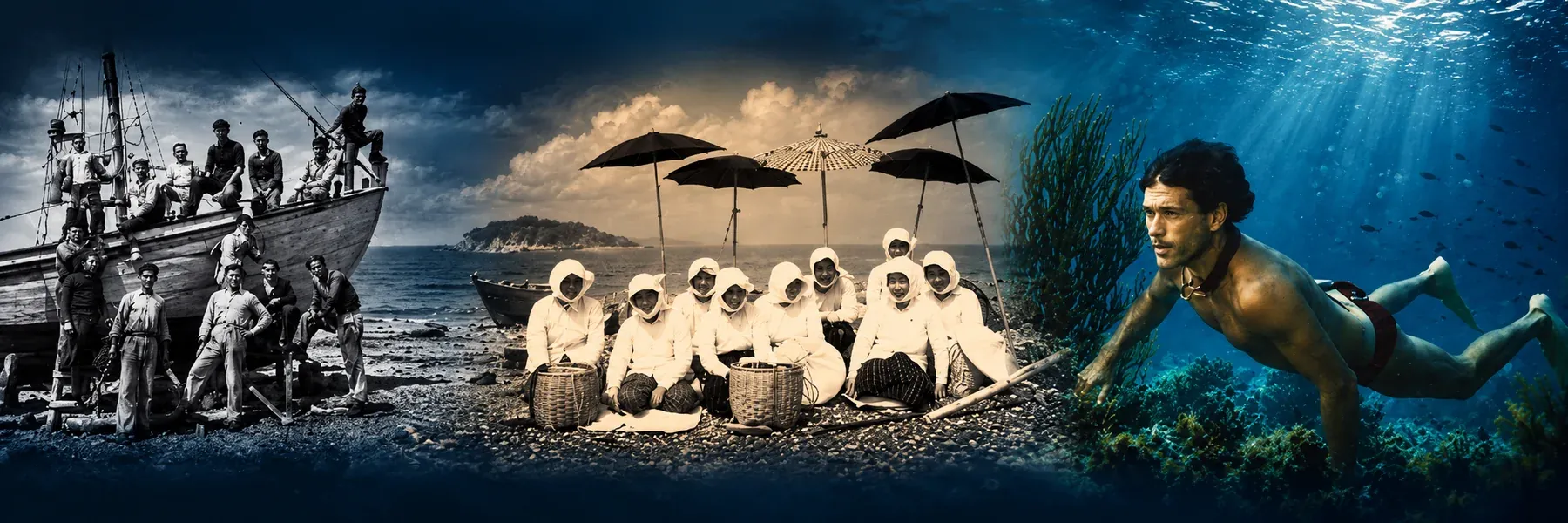
Long before scuba cylinders or underwater computers, people were already diving beneath the surface. They gathered food, recovered anchors, collected pearls and sponges, hunted fish and discovered a world inaccessible from shore.
Over the centuries, those activities evolved in many directions. Underwater workers and fishing communities developed effective techniques; inventors transformed equipment; scientists examined pressure and breath-holding; athletes pursued records. Today traditional breath-hold diving, spearfishing, photography, recreation and international competition coexist, often for very different reasons.
This is their connected history.
CHAPTER 01
Prehistory and the Origins of Underwater Gathering
Long before anyone invented scuba equipment, divers were already entering the water to obtain food and useful materials. A shoreline provided shellfish, crustaceans, fish and edible plants; some could be collected at low tide, while other resources required swimming and deliberate submersion. Breath-hold diving probably arose independently in many coastal communities, rather than from a single inventor or civilization.
Archaeological shells, fishing implements and marine-food remains demonstrate ancient relationships with the sea, but they do not always prove underwater diving. We cannot reliably date the first deliberate human breath-hold descent. That uncertainty is important: many popular histories repeat very ancient dates as though they represented verified freediving records.
Early underwater knowledge came from experience: recognizing currents and sea conditions, judging the distance to an object, equalizing the ears, moving economically and knowing when to surface. The immediate purpose was almost never a depth record. People entered the sea because food, livelihood or something valuable lay beneath it.
Early coastal communities learned to exploit marine environments using their bodies long before any purpose-built diving apparatus existed. The evidence, however, must be read carefully: shells found in ancient settlements demonstrate gathering and consumption, not the precise method by which the shells were obtained. A diver collecting an abalone below the surface and a person picking shellfish from an exposed rock shelf could leave indistinguishable archaeological traces.
Repeated underwater work required practical knowledge that could be transmitted without writing: swimming technique, recognizing conditions, returning to a familiar place and estimating how much effort remained for the journey back. It is plausible that independent communities developed these skills, but claims that freediving began on one exact prehistoric date are not supported by a universal archaeological record.
↑ Back to chaptersCHAPTER 02
Greek, Roman and Ancient Maritime Divers
Written sources from the ancient Mediterranean offer clearer evidence of specialized divers. Greek communities harvested natural sponges for domestic and medical use, while underwater workers recovered anchors, equipment and cargo. The occupation combined physical skill with intimate knowledge of seabed terrain and boat operations.
Roman professional divers are associated with the name urinatores. Inscriptions provide evidence for organized groups of underwater workers, while ancient narratives describe diving in the service of shipping, salvage and military operations. Their roles should not be reduced to a single heroic anecdote: much of the work was commercial and repetitive.
Ancient underwater military activity included accounts of reconnaissance, removal of obstacles, interference with vessels and support for operations near fortified harbours. Individual stories vary in reliability, but they show that capable divers were valued well before compressed-air equipment existed.
Greek texts associated with Herodotus and later writers describe specialized swimmers and divers. By Roman times, the term urinatores was linked to underwater work, and inscriptions attest to organized associations. Their activities connected diving to commercial ports, ships, fishing and military needs rather than an independent recreational sport.
The archaeological setting matters. In a world dependent on maritime transport, a lost anchor or obstructed harbour could have economic and strategic consequences. Experienced swimmers could help recover cargo or examine something out of reach of ordinary sailors. The methods and attainable depths varied, so accounts of exceptional exploits should not be generalized to every ancient diver.
↑ Back to chaptersCHAPTER 03
Legends, Myths and Extraordinary Early Accounts
Among the most famous ancient tales is that of Scyllis of Scione and his daughter Hydna. Traditions associated with the Persian Wars credit them with using their diving abilities to sabotage Persian ships. Historians can discuss the account and its sources without claiming that every detail is independently verified.
Legends of remarkable pearl divers, sponge fishermen and underwater messengers travelled across maritime societies. Deep water was hidden from observers on shore; that invisibility helped transform skilled underwater workers into mysterious figures. An astonishing story may preserve a genuine memory of a remarkable diver while embellishing depth, time or circumstances.
Legends remain part of maritime heritage, but they should not receive the same evidentiary status as documented naval reports or modern federation-ratified results.
The tale of Scyllis and Hydna is particularly instructive. An ancient narrative may preserve the importance of expert swimmers during naval warfare, but the familiar details about secretly cutting anchor ropes beneath hostile ships cannot be verified as a modern eyewitness account. Stories of Alexander the Great and underwater adventures likewise belong to the history of imagination surrounding the sea, not to a list of certified descents.
Myth and history need not compete. The stories show how communities understood extraordinary physical ability: a diver could disappear, operate beyond ordinary sight and return from a place most people could only imagine. Separating the narrative tradition from independently established facts gives these accounts a more meaningful role in underwater history.
↑ Back to chaptersCHAPTER 04
Japanese Ama and Korean Haenyeo
Japan’s ama represent a longstanding tradition of harvesting abalone, shellfish, seaweed and other marine resources. Some methods involved comparatively shallow independent descents, while boat-supported methods used weights, ropes and the help of surface partners. The terms kachido and funado are associated with different working arrangements, although customs varied by place and period.
Ama are frequently portrayed as pearl divers, but this misses much of their traditional work. Food gathering and local maritime livelihoods were central; the cultured-pearl industry later influenced international imagery of the ama, including distinctive clothing and promotional photographs. Their equipment changed from early underwater eye protection to masks and modern thermal suits.
On Jeju Island, Korea’s haenyeo developed an equally important tradition of repeated breath-hold harvesting. Their work requires environmental knowledge, teamwork and experience with tides, weather and marine resources. Knowledge has traditionally moved across generations within coastal communities.
UNESCO recognized the culture of Jeju haenyeo as Intangible Cultural Heritage in 2016. This recognition speaks to a history of work, identity and stewardship—not simply exceptional breath-holding performance. Traditional women divers must remain central to any account of freediving history.
In Japan, the distinction between independent shore-based diving and boat-supported work illustrates how a seemingly simple act became an organized occupation. Food harvesting, seasonal conditions and knowledge of particular grounds defined the practice. The popular description ‘pearl diver’ is inadequate because abalone, shellfish and marine plants were often more central than natural pearls.
Jeju haenyeo organize their working life around shared knowledge, cooperation and an understanding of the marine environment. Their culture includes an inherited vocabulary, community rules and rituals as well as the physical act of diving. The UNESCO recognition in 2016 acknowledges this broader heritage, not simply impressive breath-holding.
Modernization brought protective suits and changing markets, but also pressure on traditional livelihoods. Both ama and haenyeo histories should be read as stories of communities adapting to technology, environmental change and the transmission of knowledge across generations.
↑ Back to chaptersCHAPTER 05
Philippine and Southeast Asian Diving Traditions
Across the island seas of Southeast Asia, underwater gathering and fishing evolved under conditions unlike those of the Mediterranean. Maritime peoples of the Philippines, Indonesia and Malaysia developed local knowledge of reefs, currents, seasonal fish movements and shallow marine habitats.
The Sama Dilaut and related Sama-Bajau communities, including communities in the Sulu Archipelago and around Tawi-Tawi, have histories closely tied to boats, fishing and marine resource gathering. Some practice repeated breath-hold diving to hunt fish or collect seafood. Their accomplishments are measured in practical work rather than a single maximum-depth performance.
Other Philippine coastal communities also engage in underwater fishing and harvesting, but methods differ locally. Not every fishing tradition involves breath-hold diving, and compressor-assisted fishing is a separate practice with different hazards. Historical accounts of Palawan, the Visayas, Mindanao and Luzon should avoid assuming one uniform national diving tradition.
Scientific attention intensified when a 2018 Cell study reported larger average spleen size and genetic evidence consistent with diving-related adaptation in a studied Indonesian Bajau population. This does not mean every Bajau diver has unusual physiology, nor does it replace experience and safety. It demonstrates how occupational history and biological research can illuminate each other.
The maritime history of the Sama Dilaut belongs to the larger Sulu Sea world of trade, migration and fishing. Communities known under different names in the Philippines, Malaysia and Indonesia share some historical connections, but should not all be presented as one interchangeable population. Working methods likewise vary by island, generation and local economy.
A working breath-hold diver may repeat relatively shallow descents for several hours while harvesting or spearing fish. Such endurance depends not only on the length of an individual dive but on local knowledge, efficient movements and an ability to judge conditions. The same activity is very different from attempting a single sporting maximum depth.
Beyond the Sulu region, other Philippine coastal communities practice underwater fishing and gathering, yet documentation must be geographically specific. The existence of fishing on an island is not evidence that its residents have an identifiable inherited freediving tradition. A separate and historically important development is compressor-assisted fishing, which uses breathing gas and therefore should not be labelled apnea.
The Indonesian Bajau research published in Cell in 2018 compared sampled populations and found evidence involving average spleen size and genetic adaptation. Its implications are fascinating, but should never be converted into claims that every member of a community can hold their breath for an extraordinary number of minutes.
↑ Back to chaptersCHAPTER 06
Pacific, Arabian Gulf and Indian Ocean Divers
Before petroleum transformed the economies of the Gulf, pearling fleets supported a complex maritime industry. Divers, surface tenders, captains and merchants worked together in seasonal operations around Bahrain and neighbouring coasts. Divers might use descent weights and collecting bags, but the value of pearls did not mean that workers necessarily enjoyed the profits of the trade.
Pearl fisheries around Sri Lanka and the Gulf of Mannar connected local diving labour to long-distance commerce. In parts of the Pacific, island communities collected shells, pearl oysters and other marine resources by breath-hold diving. The practices of individual communities must be told in their own geographical and cultural contexts rather than grouped into a single generic tradition.
In French Polynesia, repeated professional breath-hold diving was associated with neurological symptoms described as taravana. These cases eventually contributed to the understanding that repetitive or extreme breath-hold diving can, under certain conditions, cause decompression illness.
Indigenous Australian and Torres Strait Islander communities had extensive traditions of marine harvesting before industrial pearling expanded. As commercial underwater work became deeper and more sustained, some industries moved toward surface-supplied breathing systems. Breath-hold practices nevertheless continued alongside newer technology.
A traditional Gulf pearling expedition was a coordinated enterprise, not a solitary adventure. Boats, captains, divers, rope tenders and merchants participated in a seasonal economy in which the oyster catch could make a considerable financial difference. Weighted descent and surface assistance helped divers work efficiently, while the trade itself reflected unequal economic power.
Pearl fisheries in the Gulf of Mannar linked South Asian coastal labour with local rulers, traders and later colonial administration. The sea provided a valuable commodity, but individual workers faced demanding conditions and uncertain rewards. Their histories connect apnea with broader developments in maritime commerce.
Across Polynesia and Micronesia, underwater work included pearl shell, other shell resources and fishing. The term taravana became associated with neurological illness reported after intensive repeated breath-hold dives, especially in Polynesian pearl-shell operations. Those reports helped overturn the simple assumption that a diver breathing only at the surface could never experience decompression illness.
↑ Back to chaptersCHAPTER 07
The Evolution of Equipment and Working Techniques
The oldest equipment might be nothing more than a stone, a rope, a basket or a spear. In Greek sponge diving, the weighted skandalopetra helped a diver reach the seabed rapidly, with surface assistance forming a crucial part of the method. Weighted descent was not an early version of a modern constant-weight sporting performance; it was designed for a working task.
Underwater goggles and later diving masks changed what a diver could actually see. Fins made propulsion more efficient; specialized long fins and monofins eventually followed as equipment designers responded to different swimming and depth disciplines. Snorkels made it easier to observe beneath the surface while breathing air between descents.
Thermal protection was another revolution. Better rubber clothing and neoprene suits extended comfortable working and exploration time, making colder seas more accessible. Meanwhile, efficient spear designs developed because hunters needed accuracy, reliability and practical underwater handling.
Modern freediving equipment now ranges from a simple mask and fins to sophisticated carbon fins, computers, depth lines, safety lanyards and organized support systems. The needs of a working shell collector, reef photographer, spearfisher and competitive depth athlete remain distinctly different.
The skandalopetra stone used by Greek sponge divers represents a sophisticated answer to one specific problem: reaching working depth quickly. A descent weight, a rope and a trained surface team could conserve energy during the downward journey, although these methods also depended heavily on the reliability of the supporting crew.
Underwater vision transformed both gathering and enjoyment. Early goggles were followed by improved masks that enclosed the eyes and nose, while practical snorkels allowed swimmers to observe below without repeatedly raising the face out of the water. Fins made movement more effective; the later monofin developed along a sporting and hydrodynamic path of its own.
Thermal protection was another turning point. Neoprene enabled longer periods in water that would otherwise become uncomfortable or exhausting. Georges Beuchat, working from Marseille, contributed to this development as well as to spearfishing equipment. Specialized electronic instruments arrived much later, turning depth, time and repeated-dive tracking into information a diver could review.
↑ Back to chaptersCHAPTER 08
Spearfishing — From Food Gathering to Modern Sport
Spearfishing has its own history and must not be treated as a side activity invented by modern record-oriented freedivers. Human communities have used spears and harpoons to obtain fish since ancient times. Underwater breath-hold hunting developed wherever local waters, available tools and fishing practices made it useful.
Modern spearfishing expanded during the twentieth century as masks, goggles, fins and underwater spear-launching devices improved. Its skills involve locating and identifying fish, approaching efficiently, reading currents and terrain, using a spear responsibly and making repeated safe returns to the surface. Its purpose differs from static apnea or a depth record.
Georges Beuchat, a passionate underwater hunter from Marseille, founded his company in 1934. His practical interest in the sea helped drive developments in spearfishing and diving equipment. The company’s history credits its influential Tarzan rubber-powered speargun to 1947 and important advances in thermal-protection suits to 1953. The broader history includes spring-powered and other early designs; Beuchat did not single-handedly invent underwater hunting.
Competitive spearfishing also predates the establishment of AIDA. CMAS histories identify a US competition in 1947, an Italian national championship in 1949, a European championship in 1954 and the first world championship in 1957 at Mali Lošinj. Athletes such as José Amengual, Renzo Mazzari and Jean-Baptiste Esclapez belong in its distinct sporting history.
Spearfishing remains a means of gathering food for some communities and a recreational or organized sport for others. Selective targeting does not automatically guarantee sustainability: local regulations, protected species, reproductive seasons and fishing pressure matter. The long history of spearfishing connects practical livelihoods, technological innovation and modern marine conservation debates.
In underwater hunting, the target moves. A good spearfisher must interpret terrain, approach quietly, identify species and decide whether an animal is an appropriate target. A maximum-depth record tells us almost nothing about that practical competence. Historical spearfishing traditions therefore intersect with freediving physiology without being reducible to competitive apnea.
The twentieth century saw experimentation with hand spears and spring-, pneumatic- and rubber-powered launching systems. Georges Beuchat, a passionate Mediterranean underwater hunter, founded his Marseille business in 1934. His well-known Tarzan speargun appeared in 1947, and his later thermal-protection innovations helped make underwater hunting and exploration more comfortable. Beuchat was not the sole inventor of every modern device; the significance of his career is the practical innovation and commercialization that followed the needs of people actually entering the water.
Spearfishing competitions formed an independent organized sporting tradition. CMAS historical material identifies important competitions in 1947 and 1949, followed by a European championship in 1954 and a world championship in 1957. Their histories feature tactical decisions, fish behaviour and local environments, not just the stopwatch and depth gauge.
Modern fishing ethics require nuance. Identifying a target individually can be more selective than some methods of capture, but vulnerable species, breeding aggregations and excessive fishing pressure can still cause harm. Responsible practice depends on local law, ecological knowledge and restraint. For coastal families, meanwhile, underwater fishing may remain an occupation rather than a sporting identity.
↑ Back to chaptersCHAPTER 09
The Nineteenth Century and the First Depth Pioneers
During the nineteenth century the introduction of surface-supplied helmets transformed Mediterranean sponge harvesting. Workers could remain underwater far longer than on a single breath, but the new equipment introduced serious decompression hazards before modern decompression science and procedures developed.
Traditional breath-hold skills persisted, and one episode became famous: in 1913, the Greek sponge diver generally remembered as Haggi Statti helped an Italian naval expedition recover a lost anchor near Karpathos. The anchor was reported at approximately 77 metres. Italian naval medical observations provide a stronger historical basis than many stories circulating around this achievement.
Names, reported performance details and claims about exceptional earlier dives vary across later accounts. The documented salvage should not be called a modern ratified sporting record. Statti was a professional underwater worker doing a job—yet his story became a bridge between working-diver history and the coming fascination with measurable depth.
During the nineteenth century, helmet and surface-supplied systems transformed commercial underwater labour. Greek sponge operators could now keep divers on the bottom for longer, but compressed-gas exposures brought accidents that were poorly understood at the time. Breath-hold techniques continued alongside newer systems where their simplicity remained useful.
The 1913 Haggi Statti story stands at the boundary between occupational diving and later record culture. His reported involvement in recovering an Italian naval anchor at approximately 77 metres is associated with naval medical documentation. Later retellings differ in names, performance details and claims about his abilities, so the historical anchor-recovery event must not be treated as a modern sanctioned depth record.
His reason for entering the water was straightforward: an object had to be recovered. The fascination of the episode lies precisely in how a working diver's exceptional practical achievement became a celebrated reference point for later sporting histories.
↑ Back to chaptersCHAPTER 10
Bucher, Maiorca, Mayol and Robert Croft
In 1949, Italian diver Raimondo Bucher was credited with a descent to approximately 30 metres near Naples. Earlier professional divers had reached great depths, but Bucher’s widely reported achievement helped establish diving depth itself as the objective of a sporting performance.
Enzo Maiorca became a central figure in the 1960s and later decades, repeatedly testing public expectations of human endurance underwater. His determination and high-profile performances helped transform deep freediving into a recognizable pursuit with celebrated personalities.
Jacques Mayol, born in Shanghai in 1927, took a different approach emphasizing relaxation, mental preparation and the relationship between humans and marine mammals. His widely recognized 100-metre descent in 1976 was a cultural and sporting milestone. It encouraged wider investigation of techniques and physiological adaptations.
American diver Robert Croft, associated with US Navy diving activities, made deep breath-hold performances during the 1960s that attracted scientific interest. His achievements challenged simple predictions about how compressed lung volume would limit depth. Together these pioneers linked individual ambition, practical experimentation and evolving physiological research.
Raimondo Bucher's reported 30-metre descent in 1949 is frequently treated as a starting point for modern depth-record freediving. It was a new public language of diving: the achievement was the descent itself, measured and discussed rather than a harvest brought back to the boat.
Enzo Maiorca's career made this ambition visible to a wider audience. Jacques Mayol approached it with a distinctive interest in relaxation and the human relationship with the sea; he became widely associated with the 100-metre milestone of 1976. Their careers became intertwined in public imagination, though real lives were more complicated than the rivalry later shown on film.
Robert Croft brought an additional perspective through US Navy connections and physiological investigation. His deep breath-hold descents in the late 1960s challenged simple predictions based on residual lung volume and helped stimulate a closer study of how a living body responds to pressure.
↑ Back to chaptersCHAPTER 11
The Late Twentieth-Century Record Generation
During the 1980s and 1990s, specialized disciplines and equipment widened the possibilities of freediving. Rather than following a single line of depth records, athletes could specialize in swimming-powered descents, line-assisted movement, variable weight or increasingly ambitious mechanically assisted dives.
Umberto Pelizzari became a prominent Italian record athlete and later educator, while Cuban-born Francisco “Pipín” Ferreras became strongly associated with the extreme assisted-depth era. Angela Bandini and other women also achieved influential performances during the development of modern deep freediving.
Luc Besson’s The Big Blue (1988) brought a fictionalized interpretation of Mayol and Maiorca to an international audience. It was not a documentary, but its imagery changed public perceptions of breath-hold diving, making silence, freedom and depth part of the sport’s popular identity.
At the same time, underwater hunters, coastal workers and ordinary recreational explorers continued diving for entirely different reasons. The growing spectacle of competitive records was only one branch of a much larger underwater world.
Umberto Pelizzari developed important records in different disciplines and became a prominent educator and public figure. Francisco Ferreras was strongly associated with the technically demanding No Limits era. Both illustrate how late-century records were shaped by changing equipment and training approaches as much as by sheer willingness to descend.
Luc Besson's 1988 film The Big Blue reached an audience far beyond the specialist diving community. Its imagery of silence, depth and intimacy with the ocean inspired many, but the script deliberately dramatized the lives of the people who influenced it. Film history and verified diving history should therefore remain distinct.
By the 1990s, training organizations, international observers and event organizers faced growing pressure to define what constituted a record. A dive with fins, a pull along a line and a descent using a heavy sled were not equivalent demonstrations of human propulsion.
↑ Back to chaptersCHAPTER 12
The Evolution of Freediving Science and Physiology
Observations of immersion and breath-holding long predate modern competition. Researchers investigated changes in heartbeat, circulation and respiration; early twentieth-century studies of Japanese ama and other professional divers connected physiology with real working conditions.
The human diving response can include bradycardia, peripheral vasoconstriction and spleen contraction. Deep immersion also involves lung compression and circulatory changes sometimes described as blood shift. These responses help explain how depth is physiologically possible, but they do not eliminate the risk of hypoxia or pressure injury.
Scientific understanding changed as divers like Croft, Mayol and later athletes reached depths that earlier simplified calculations had portrayed as impossible. Work on pulmonary mechanics and oxygen transport revised expectations without establishing a universally safe depth for all humans.
The 2018 Bajau study added an extraordinary long-term perspective: generations of maritime work may be associated with inherited physiological adaptations within particular populations. Such findings should not be exaggerated into claims that an ethnic group is naturally immune to underwater hazards.
Modern research also clarified that the urge to breathe does not measure remaining oxygen reliably. Hypoxic loss of consciousness, pulmonary injury and decompression illness in certain patterns of repeated diving demonstrate the continuing importance of disciplined safety practice.
The response commonly called the mammalian diving response includes bradycardia and changes in peripheral blood flow. It is influenced by breath-holding, immersion and individual circumstances. The contraction of the spleen can also increase the concentration of circulating red blood cells, but these physiological changes do not eliminate the dangers of low oxygen.
As ambient pressure rises, the air spaces of the body are compressed. Earlier depth predictions that treated the lung as a simple fixed-volume container did not adequately account for circulatory and mechanical responses. Investigations of professional divers, naval subjects and later world-class athletes helped refine the science.
Hypoxia remains a central risk. The urge to breathe is strongly influenced by carbon dioxide and cannot be used as a dependable oxygen meter. During ascent, falling ambient pressure may further reduce alveolar oxygen partial pressure even as the diver approaches the surface. This is one reason direct supervision and properly trained safety companions became central to modern education.
Physiological adaptation and expertise are separate from invulnerability. Traditional populations provide important evidence about human flexibility, but neither occupational experience nor exceptional competitive achievement abolishes the effects of pressure and oxygen limitation.
↑ Back to chaptersCHAPTER 13
The Establishment of CMAS and AIDA
Underwater sports became increasingly organized after the Second World War. The Confédération Mondiale des Activités Subaquatiques (CMAS) was founded in 1959, bringing together national underwater-sport federations. Jacques-Yves Cousteau became its first president. Spearfishing and other underwater sporting traditions were important in this institutional development.
The International Association for the Development of Apnea (AIDA) was established in 1992 to support standardized competitive breath-hold diving, records and organized events. Specialized disciplines made it possible to distinguish swimming-powered performances from weighted or assisted descents.
AIDA and CMAS have developed separate frameworks and record classifications. A historical performance should be identified by year, discipline, supervising organization and ratification status; a record in one system does not automatically have the same status in another.
Training also expanded beyond informal transmission from experienced workers or club members. Modern instructional approaches included equipment familiarity, equalization, buddy practices, rescue, physiology and supervised progression. Formal systems complemented—but did not erase—the knowledge of traditional diving cultures.
CMAS was founded in 1959 within an environment of international underwater sport that included spearfishing, swimming with fins and recreational exploration. Jacques-Yves Cousteau was its first president. Its institutional history shows why spearfishing has an independent place in the evolution of underwater sports.
AIDA, founded in 1992, offered a dedicated framework for competitive apnea with organized disciplines, procedures and record supervision. Different governing bodies subsequently maintained distinct competition classifications and recognized results. For historical accuracy, a world record should therefore always be accompanied by its discipline and governing authority.
Formal instruction grew alongside the sport. Traditional skills had previously passed through families and local working groups; modern courses organized equalization, physiology, buddy supervision, rescue and performance progression into structured learning systems.
When CMAS was part of the depth-record story
Long before AIDA existed, the rivalry between Enzo Maiorca and Jacques Mayol was unfolding in a sporting world already connected to CMAS. The federation did more than bring underwater clubs together: it was involved in the recognition of early breath-hold depth achievements. The increasing attention given to record descents also raised difficult questions. Who measured the depth? Who witnessed the dive? What equipment was permitted? And what responsibility did an organizing body assume when a diver attempted to descend farther than anyone before?
From the 1960s, CMAS helped give early depth achievements an international sporting framework. But as attempts pushed deeper and the medical consequences remained uncertain, the federation became increasingly reluctant to approve extreme-depth performances. Around 1970, CMAS largely withdrew from ratifying such record attempts because of safety concerns. This was not the end of apnea as an underwater sport, nor did it prevent individuals from continuing their descents. It did create a gap between spectacular achievements and consistent official recognition.
That distinction matters when discussing Jacques Mayol's 100-metre descent in 1976. It was an extraordinary milestone and a pivotal moment in freediving history, but it should not automatically be described as a CMAS-ratified world record under the earlier system. The athlete's accomplishment and the federation's recognition are separate historical questions.
The Big Blue — what the CMAS banners tell us
Luc Besson's The Big Blue (1988), inspired by Maiorca and Mayol, places conspicuous CMAS banners around the boats and diving events. They are an easily overlooked visual clue to the federation's place in the public history of competitive breath-hold diving. The U.S. Freediving Federation's account of freediving history specifically notes that the film depicts CMAS sanctioning its competitions.
Yet the movie is a dramatization, not an archive of officially approved record attempts. Its presentation combines the recognizable atmosphere of organized underwater sport with fictionalized events. The real history is more revealing: CMAS helped establish early recognition, withdrew from much extreme-depth ratification around 1970, and the athletes continued setting ambitious goals even when a unified sanctioning framework was absent.
Why AIDA emerged — and what both organizations do
By the early 1990s, different methods of descending and returning—constant weight, free immersion and assisted-depth attempts—needed clear definitions and comparable records. French freediving figures Roland Specker and Claude Chapuis were among those who helped create AIDA in 1992. Its specialized purpose was to formalize competition rules, supervise events, recognize performances and maintain records that could be compared within defined disciplines.
CMAS resumed recognizing freediving records in the mid-1990s, and today both organizations have significant roles in competitive apnea. Their regulations and record lists are not always interchangeable. In a sanctioned event, the governing framework determines the discipline, permitted equipment, athlete eligibility, measurement and judging requirements, safety and medical arrangements, and whether a result may be ratified. Competition organizers and accredited officials put those requirements into practice; a witnessed dive does not become an official world record simply because somebody announces a number.
Modern CMAS runs world and continental championships, maintains rankings and publishes rules for pool and depth disciplines; AIDA likewise has competition and record-attempt procedures and its own recognized results. The CMAS competition and record regulations and AIDA competition rules illustrate their practical functions. Neither organization created humanity's breath-hold diving traditions: their contribution was to establish sporting structures for certain forms of apnea while working divers, spearfishers and recreational explorers continued along their own paths.
↑ Back to chaptersCHAPTER 14
Understanding Modern Freediving Disciplines
Competitive freediving uses several different measurements. Static Apnea (STA) measures stationary breath-hold duration. Dynamic With Fins (DYN), Dynamic Bifins (DYNB) and Dynamic Without Fins (DNF) measure horizontal distance in a pool, with the indicated propulsion method.
Vertical categories include Constant Weight (CWT), in which the diver descends and ascends using their own propulsion with fins or monofin; Constant Weight Bifins (CWTB), which uses separate fins; and Constant Weight Without Fins (CNF), which relies on finless swimming. In Free Immersion (FIM), the athlete moves along a line using the arms without fin propulsion.
Variable Weight (VWT) allows weighted descent with an ascent based on swimming or permitted rope assistance. No Limits (NLT) has historically used sled-assisted descent and buoyancy-assisted ascent, enabling exceptional depths but introducing complex technical risks. Historical No Limits records remain part of freediving history even though AIDA no longer sanctions the category.
The traditional Greek skandalopetra has been revived in organized events, but should be discussed separately from conventional modern depth records. Spearfishing has its own objectives, competition formats and history; underwater photography, reef observation and casual recreational breath-hold swimming are important non-competitive activities rather than measured record disciplines.
Static apnea measures time rather than distance. Dynamic disciplines measure horizontal travel in a pool; the distinctions between a monofin, two separate fins and no fins affect how the performance is judged. Depth disciplines similarly distinguish swimming with propulsion, swimming without fins and pulling on a rope.
Variable Weight uses assistance on descent but not the same fully assisted return employed in No Limits. Those differences are critical: the very deep assisted descents of the No Limits era cannot fairly be compared with constant-weight swimming performances. The historical skandalopetra is a separate tradition using a stone and surface support.
Competitive classifications also change. A historically recognized category may no longer be actively sanctioned under a particular federation's current rules. Spearfishing belongs in the broader history because it is an established underwater sport, but it is not simply another AIDA pool or depth category.
↑ Back to chaptersCHAPTER 15
Women Pioneers and Competitive Achievements
Women’s underwater history did not begin with formal competition. Generations of Japanese ama and Korean haenyeo demonstrated highly developed occupational skills and preserved maritime knowledge. Their work belongs in the central narrative, not an appendix to male sporting records.
Angela Bandini helped pioneer ambitious women’s assisted-depth performances in the late 1980s. Tanya Streeter reached 160 metres in a recognized No Limits performance in 2002, a milestone in the history of the women’s category.
Audrey Mestre became internationally known for extreme No Limits dives. Her fatal accident during a 2002 attempt later prompted intense scrutiny of the organization and safety of such performances.
Natalia Molchanova became an exceptionally accomplished athlete across multiple disciplines, with extensive championship and record achievements. Her educational contribution was also substantial; her disappearance during a recreational dive in 2015 affected the entire freediving community.
Athletes including Alenka Artnik, Alessia Zecchini, Kateryna Sadurska and Zsófia Törőcsik continued advancing depth and pool performance. Their achievements must be presented with discipline-specific dates and governing-body recognition rather than a single unqualified claim about the deepest woman.
Angela Bandini helped demonstrate the possibilities of women's assisted-depth diving in the 1980s. Tanya Streeter's 160-metre No Limits performance in 2002 became a landmark. Audrey Mestre's achievements belong to the same period, although her death during an attempted record in October 2002 profoundly changed how many participants viewed the responsibilities of extreme-depth operations.
Natalia Molchanova became one of the defining athletes of modern competitive apnea, excelling across multiple disciplines and helping build teaching methods. Her disappearance in 2015 was a tragic reminder that exceptional skill does not remove all underwater risks.
Subsequent champions including Alenka Artnik, Alessia Zecchini, Kateryna Sadurska and Zsófia Törőcsik have continued to develop specialized competitive performance. Their achievements should be documented with the exact discipline, date and federation rather than combined into one misleading ranking.
↑ Back to chaptersCHAPTER 16
Historical Depth, Distance and Time Records
There is no single, universal freediving world record. Performance must be interpreted by technique, permitted equipment, supervising organization and date. A sled-assisted No Limits descent is not equivalent to a constant-weight dive; a static breath-hold is not comparable to a horizontal-distance record.
Milestones include the famous 1913 Haggi Statti anchor recovery near 77 metres (historical working dive); Raimondo Bucher’s approximately 30 metres in 1949; Robert Croft’s remarkable deep performances in the 1960s; and Jacques Mayol’s widely recognized 100-metre milestone in 1976.
In the assisted-depth era, Tanya Streeter reached 160 metres in 2002. Austrian freediver Herbert Nitsch reached 214 metres in 2007 in an AIDA-certified No Limits performance. His 2012 descent to approximately 253 metres is recorded under a separate recognition framework and was followed by severe decompression illness.
Modern pool and depth records change regularly. The definitive current tables should be consulted directly through AIDA and CMAS, with attention to pending performances, final ratification and differences in categories. This historical chapter therefore emphasizes verified milestones rather than embedding an undated list presented as permanently current.
Herbert Nitsch's 214-metre No Limits descent in 2007 remains distinct from the 253-metre performance he reported in 2012. The latter is recognized in a separate record context and was followed by severe decompression injury. Mixing them under one federation's label would obscure an important difference in how records are documented.
Time, horizontal distance and depth each produce different measurements. A static breath-hold cannot be compared with a dynamic swim; a sled-assisted dive cannot be equated with constant-weight propulsion. Earlier achievements by working divers often lacked the measuring procedures and supervision required by today's record authorities.
A durable historical record database should therefore include the athlete, country, date, site, exact discipline, depth or time, record authority, ratification status and original supporting source. This makes the chronology both useful and honest when newer performances supersede older ones.
↑ Back to chaptersCHAPTER 17
Accidents, Discoveries and the Development of Safety
The ability to remain submerged on a single breath has clear physiological limits. Hypoxic loss of consciousness can occur with little useful warning, particularly near ascent or immediately after surfacing. Attempts to suppress the urge to breathe through inappropriate preparation can make the danger greater.
Increasing pressure can affect the ears, sinuses and lungs. Certain repetitive or very deep breath-hold profiles can also involve decompression illness—a lesson drawn in part from the experiences of working divers in Polynesia and other regions.
The death of Audrey Mestre during an extreme No Limits attempt in 2002 and Herbert Nitsch’s serious decompression accident in 2012 exposed the consequences of equipment failure, extreme exposures and insufficient safeguards. Such incidents should be discussed factually, without treating a tragedy as entertainment.
Modern organized training and competition increasingly emphasize supervised progression, suitable equipment, trained safety divers, direct buddy observation, rescue competence and emergency preparedness. The most valuable historical development is not merely that humans can dive farther; it is that we have learned more about the limits and risks of attempting to do so.
Severe hypoxia can cause loss of consciousness with little reliable subjective warning. Hyperventilation can suppress the carbon-dioxide-driven urge to breathe without safely increasing oxygen reserves, making unsupervised breath-hold practice especially dangerous. The history of safety education is therefore closely tied to improved understanding of respiratory physiology.
Pressure injuries can affect ears, sinuses and lungs, and repeated deep breath-hold profiles can sometimes involve decompression sickness. Historical reports of taravana among Polynesian working divers and later medical investigations helped change the assumption that apnea diving could never produce nitrogen-related injury.
Extreme assisted-depth dives added failure modes involving equipment, lift systems and evacuation. The accidents involving Audrey Mestre in 2002 and Herbert Nitsch in 2012 became prominent demonstrations of why competent surface organization, suitable equipment and contingency procedures are indispensable. The history deserves careful factual treatment, not spectacle.
↑ Back to chaptersCHAPTER 18
Modern Recreational Freediving and the Philippines
Most people who enjoy breath-hold diving do not intend to break a world record. A mask, snorkel and fins can open the underwater world to anyone with suitable swimming ability, safe conditions and sensible supervision. Watching reef fish, moving gently through sunlight or making a short shallow descent can be an end in itself.
That relative simplicity matters in countries where imported scuba equipment, certification, boat services and repeated cylinder fills may be costly compared with local incomes. Recreational freediving is not cost-free—proper training and safety support remain important—but ordinary shallow-water exploration is less equipment-intensive than scuba.
In the Philippines, traditional maritime fishing and gathering coexist with recreational snorkeling, modern spearfishing, underwater photography and organized freediving instruction. Batangas, Cebu and Moalboal have become recognized destinations for contemporary recreational freediving, while working underwater traditions have much older and more varied local histories.
Social media and underwater video have introduced new audiences to the sense of freedom that comes from descending without a tank. They also create pressures to imitate glamorous images or extreme dives without appropriate experience. The history should make room for both the opportunity and the responsibility.
A traditional coastal fisher, a recreational reef explorer, a spearfisher and a competition athlete all use breath-hold diving, but for different purposes. Their activities should be respected on their own terms. Thousands of years after the first underwater gatherers, one of freediving’s greatest attractions remains unchanged: curiosity about what lies beneath the surface.
For that moment, no world record is necessary. The experience itself is enough.
The Philippines brings the long historical narrative back to everyday experience. Its coral reefs, warm-water coastlines and maritime communities provide many reasons to swim beneath the surface. Some people fish or gather food, others practice underwater photography, and others simply want to explore a reef with a mask and fins.
A comparatively inexpensive mask, snorkel and fins can make shallow exploration possible without cylinders, regulators, compressed-gas fills or much of the equipment associated with scuba. That difference matters where imported equipment, formal qualifications and boat services are expensive relative to local wages. Structured freediving instruction, however, still costs money, and affordable equipment does not remove the need for competence and supervision.
The recent growth of recreational freediving in locations such as Batangas and Cebu has also been influenced by tourism, local instruction and underwater imagery shared online. That development should be distinguished from the much older occupational histories of Sama Dilaut and other coastal communities: both involve apnea, but their cultural and economic purposes differ.
The story ends where it began—with a person who wants to see what lies below the surface. Some dive for food, some for work, some to take a photograph and some to pursue a measurable record. None of those purposes alone defines the whole history of freediving.
↑ Back to chapters