
DiverInterCom · KCore Scuba Info
Science Under WaterUnderwater Biology
Science below the surface is much more than biology. Divers can contribute to archaeology, geology, oceanography, environmental monitoring, mapping and research. But biology is the natural first step: learning to recognize habitats, communities, organisms and the ecological relationships we can observe during an ordinary dive.
From the shoreline to the abyss — learn to read the underwater world
Before memorizing species names, first understand the environment. Where are we? What physical conditions exist here? Which organisms can live here, and why?
When divers hear science under water, the first thing that often comes to mind is biology: fish, corals, algae, seagrass, nudibranchs, crabs and the countless forms of life encountered on a dive. Yet underwater science also includes underwater archaeology, geology, limnology, oceanography, environmental monitoring, research diving, mapping and photogrammetry.
For a diver beginning this journey, underwater biology is the ideal starting point because it teaches us to see more than individual animals. It teaches us to read the whole underwater landscape.
This introductory approach follows a classic field-teaching logic used in diver-oriented marine biology: understand the habitat first, then observe the organisms and their relationships in the water.
Course Overview
1. The Underwater World Is Divided Into Habitats
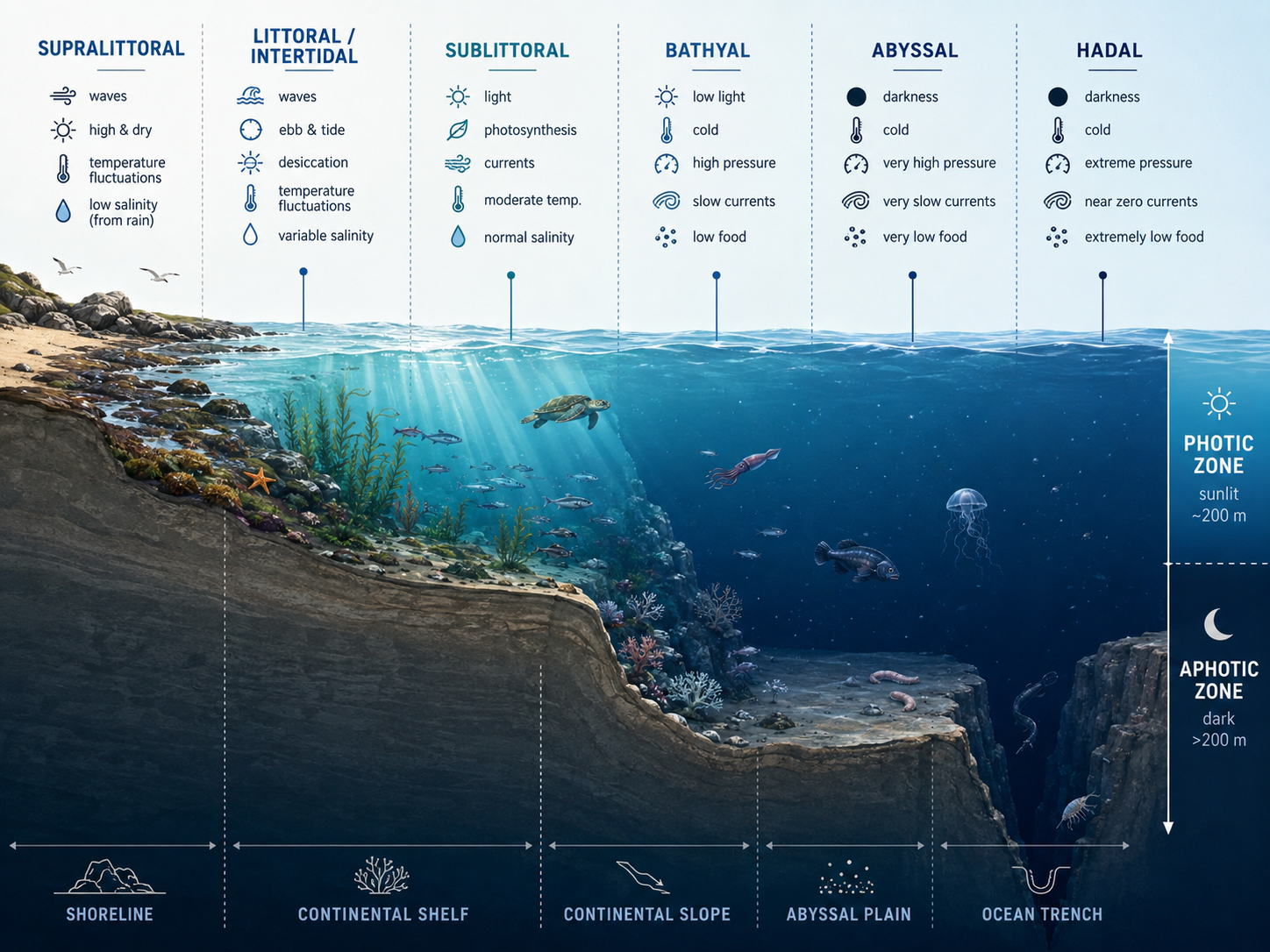
The sea is not one uniform body of water. From the dry beach to the deepest ocean trench, light, pressure, temperature, water movement, oxygen, nutrients and the nature of the seabed change continuously. Those physical differences create different habitats and biological communities.
Marine biologists therefore use ecological zones to describe the changing environment from shore to deep ocean. The boundaries are tools for understanding nature rather than hard lines painted into the sea.
2. Supralittoral — Where Land Meets the Sea
The supralittoral zone lies above the normal high-tide line but remains strongly influenced by salt spray, storms and waves. Organisms here must tolerate drying, strong sunlight, rapid temperature changes and changing salinity.
First ecological lesson: an organism lives where its adaptations allow it to survive the local conditions.
3. Littoral / Intertidal — Between High and Low Tide
The littoral or intertidal zone is alternately submerged and exposed. Rocky shores often show visible bands of barnacles, mussels, algae, limpets and snails. Sandy shores may look empty, but much of their life is buried within the sediment.
Infauna live inside sediment; epifauna live on the surface. Not seeing an animal does not mean there is no life.
4. Sublittoral / Subtidal — The Diver’s World Begins
Below normal low tide begins the sublittoral or subtidal zone, extending across the continental shelf. This is where most recreational scuba diving takes place.
Provides attachment surfaces, cracks, overhangs and shelter for algae, sponges, bryozoans, tunicates, corals, anemones and many other organisms.
An ecosystem of buried bivalves, worms, crustaceans, flatfish, gobies, rays, burrowing animals and microorganisms.
In the Mediterranean, Posidonia oceanica is a true flowering plant. Meadows stabilize sediment and create nursery and shelter habitat.
Three-dimensional habitat that combines builders, grazers, filter feeders, predators, cleaners and countless microhabitats.
5. The Photic Zone — Follow the Light
The upper water column where enough sunlight remains for photosynthesis is the euphotic or sunlit zone. Its depth varies with water clarity, but in clear open ocean it may reach roughly 200 m.
Light supports phytoplankton, algae and seagrasses. These primary producers form the energetic foundation of aquatic food webs. Light therefore determines far more than visibility: it helps determine where entire ecosystems can exist.
6. Pelagic Water — Plankton, Nekton and Benthos
Plankton drift mainly with water movement; nekton are active swimmers such as many fishes, squid, sharks and marine mammals; benthos are organisms associated with the seabed.
This simple division is one of the most useful starting concepts for a beginning underwater-biology student.
7. Bathyal, Abyssal and Hadal — Into the Deep Ocean
Beyond the continental shelf the seafloor descends through the bathyal region. Light disappears, temperature generally falls and food becomes less abundant. Organic material sinking from above — often called marine snow — connects deep communities to surface production.
The abyssal plains lie kilometres below the surface: dark, cold and under enormous pressure, yet still inhabited. Deeper still, ocean trenches form the hadal zone, generally below about 6,000 m.
Life occupies almost every aquatic environment where usable energy, suitable chemistry and liquid water make survival possible.
8. Two Maps of the Same Ocean
You may hear littoral – sublittoral – bathyal – abyssal – hadal, but also epipelagic – mesopelagic – bathypelagic – abyssopelagic – hadalpelagic.
The first system commonly describes the seabed and benthic environment; the second divides the water column by depth and light. One map describes the bottom. The other describes the water above it.
9. What Is Underwater Biology?
Biology is the science of life. Underwater biology studies life in oceans, seas, estuaries, lakes, rivers, streams, springs and submerged cave systems. Marine biology is one branch of this larger aquatic field.
We do not stop at identifying an organism. We ask where it lives, what it eats, what eats it, how it reproduces, what conditions it requires and how it interacts with other species. That takes us from identification into ecology.
10. Flora, Fauna — and More
Fauna means animal life. Flora traditionally refers to plant life. Divers often casually place algae under “flora,” although modern biology recognizes algae as a biologically diverse collection that is not simply equivalent to true plants.
Underwater ecosystems also contain bacteria, archaea, protists, fungi and microscopic algae. Much of the biological world around a diver is invisible to the naked eye.
11. Habitat, Biotope, Biocoenosis and Ecosystem
A habitat is the environment in which an organism lives. A biotope is a relatively uniform physical living space. The organisms inhabiting it form the biocoenosis — the biological community or Lebensgemeinschaft.
As an introductory simplification:
Biotope + biocoenosis = ecosystem.
The physical environment and its living community continuously influence one another.
12. Why the Same Dive Site Changes with Depth
Depth changes light, temperature, pressure, water movement, substrate conditions, food availability and sometimes oxygen. That is why the biological community at 3 m can differ strongly from the community at 15 or 35 m.
Instead of only thinking “there are fewer plants here,” the biology student begins asking: what changed in the environment?
13. Freshwater — Lakes and Rivers
Freshwater environments follow the same ecological principles but create different systems. Lakes are commonly described with littoral, limnetic, profundal and benthic zones.
Temperate lakes can develop thermal layers: the warm epilimnion, the transition layer or metalimnion containing the thermocline, and the colder hypolimnion. Divers often feel this ecological structure directly as they cross a thermocline.
Rivers add the strong influence of current. Riffles, runs, pools, gravel, sand, mud and submerged vegetation create a mosaic of habitats, each supporting organisms adapted to different flow conditions.
14. The Reef — A Living Underwater Neighborhood
For many recreational divers, the reef is where underwater biology becomes immediately visible. A reef is not simply a collection of colorful corals and fish. It is a complex ecosystem in which animals, algae, microorganisms, sediment, water movement, light and nutrients interact.
Reef-building corals create three-dimensional habitat that provides food, shelter, nursery areas and breeding space for many other organisms.
Corals are animals
The living coral is made of tiny animals called polyps. Many reef-building corals produce calcium-carbonate skeletons. Shallow-water reef-building corals commonly live in close association with photosynthetic symbiotic algae often called zooxanthellae.
This partnership helps explain why many major coral reefs develop in clear, shallow, well-lit tropical and subtropical waters.
15. Reef Fish — Learn the Ecological Roles
Before memorizing hundreds of species, it is useful to recognize what fishes are doing in the ecosystem.
Parrotfishes, surgeonfishes and rabbitfishes graze algae or plant material and can strongly influence reef surfaces.
Anthias, chromis and fusiliers often hover above the reef and feed on food delivered by moving water.
Wrasses, goatfishes, triggerfishes and others pick, dig, crush or search for invertebrates.
Groupers, snappers, moray eels, scorpionfishes and barracuda use very different hunting strategies.
Cleaner fishes and shrimps remove parasites or tissue from larger animals at recognizable cleaning stations.
Gobies, blennies, shrimp, crabs, nudibranchs, pipefish, seahorses and juvenile fishes occupy tiny microhabitats.
The useful biological question is not only “What species is this?” but also “What is it doing?”
16. The Big Animals Recreational Divers May Encounter
Depending on region and season, recreational divers may encounter reef sharks, pelagic sharks, rays, eagle rays, manta rays, turtles, large groupers, barracuda, tuna, jacks and trevallies, whale sharks, dolphins and occasionally whales.
Sharks
Sharks occupy many ecological roles. Some are large predators; others feed on smaller fishes, crustaceans or bottom animals; whale sharks filter plankton. The useful question is: which species is it, what is it doing, and why is it here?
Rays and manta rays
Bottom-associated rays often search sediments for prey, while manta rays are open-water plankton feeders. Eagle rays may cruise across reefs and sand flats.
Turtles
Different turtle species have different diets and habitat use. A turtle encounter becomes biologically richer when we observe whether it is feeding, resting or travelling.
Pelagic visitors
Tuna, jacks, oceanic sharks, mantas, whale sharks, dolphins and whales may appear because of currents, plankton abundance, prey movements, spawning events, season or migration. The reef is connected to the wider ocean.
17. Reefs Connect Many Habitats
A fish may spend its juvenile life in mangroves or seagrass and later move onto a reef. A turtle may travel between seagrass beds, reefs and open water. Pelagic animals may approach a reef because currents concentrate food there.
The underwater landscape is therefore not a collection of isolated boxes. It is a network of connected habitats and communities.
18. The Diver as Observer
A diver can enter the habitat and observe feeding, camouflage, competition, cleaning, mating, schooling, burrowing and predator–prey relationships directly. That access also creates responsibility.
Look first — touch rarely. Good buoyancy, trim and propulsion are tools of responsible biological observation.
19. The First Rule of Underwater Biology
You do not need to be a professional biologist to begin thinking scientifically underwater. Start with simple observations and connect the organism to its surroundings.
Do not ask only: “What is it?” Also ask: “Why is it here?”
That question connects species → habitat → community → ecosystem. Once a diver begins thinking that way, even a familiar dive site becomes a much richer place.
Science Under Water — Where We Can Go Next
Underwater Biology & Ecology · Freshwater Biology & Limnology · Underwater Archaeology · Marine Geology · Oceanography · Research Diving · Environmental Monitoring · Sampling & Scientific Diving Methods · Underwater Mapping & Photogrammetry.