
01 / The exploration
The cave that kept descending
Far below the surface of Matka Canyon in North Macedonia, the world of open-water scuba diving has long disappeared. There is no direct ascent, no daylight above, and no simple way home. In October 2026, the BAD Exploration Team and Dive Club “Vrelo”–Matka returned to find out where the cave went beyond the 287-metre limit reached the year before.
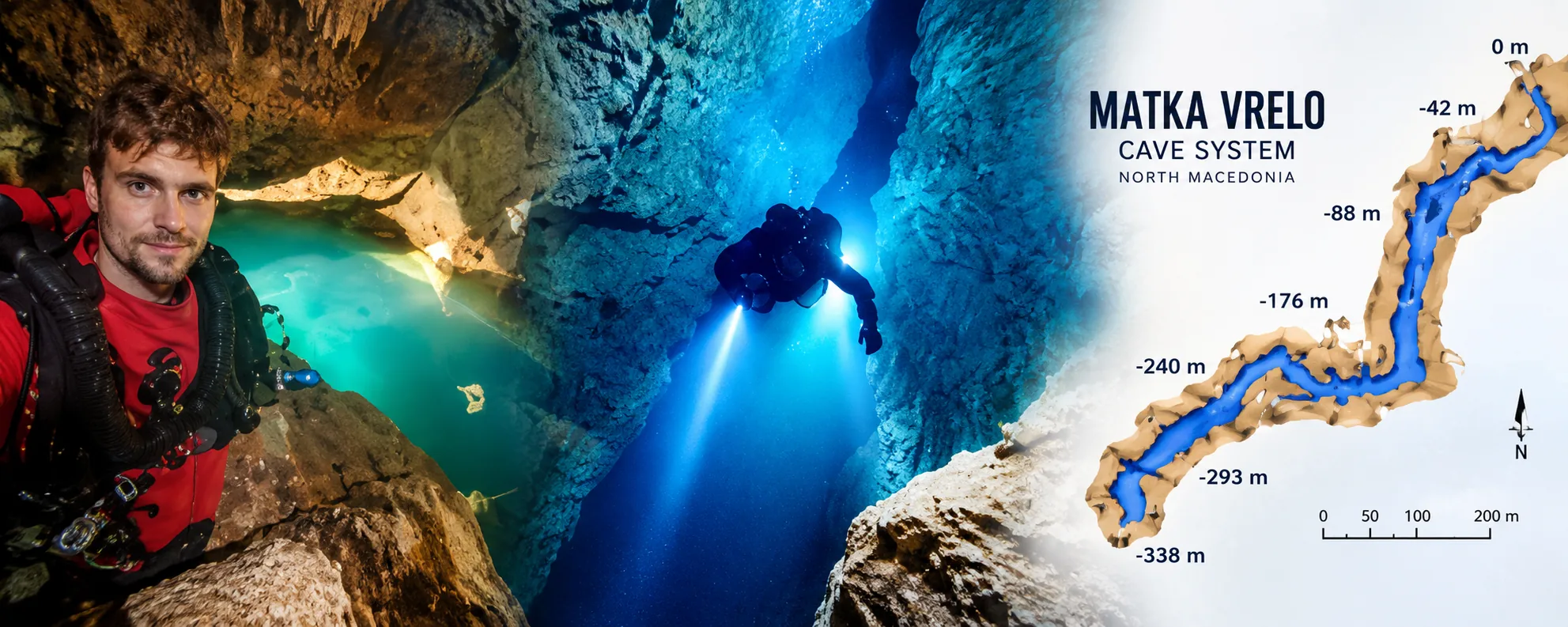
On 16 October, Polish cave diver Bartłomiej Pitala reached 338 metres beneath the water's surface in Matka Vrelo. He did not find the end. The passage beyond his turning point was still dropping steeply into darkness. The reported dive surpassed the previous 312 m cave-diving depth mark associated with Xavier Méniscus at Font Estramar, and exceeded Ahmed Gabr's Guinness-listed 332.35 m open-water scuba depth. Formal record categories and ratification should not be confused: as of publication, this was a documented and widely reported record claim, not a newly ratified Guinness World Record.
Matka Vrelo is located in Matka Canyon, west of Skopje. The 10–17 October international expedition also reported discovering two additional cave passages, adding more than 150 metres of explored underwater passage to the system.
02 / Preparation and support
Before the final descent
Months of preparation culminated in four progressive dives during expedition week, reaching 150, 190, 240 and 290 metres. These provided opportunities to inspect lines, distribute bailout resources, assess equipment and response to high-pressure neurological syndrome (HPNS), and refine the final dive plan.
The support system was extensive: more than 25 bailout cylinders were placed within the cave, as deep as 180 metres. Seven support divers took part in the final dive. A heated or warm air-filled decompression habitat was installed at about 8 metres as an emergency option, with rescue boats, medical specialists, and evacuation capabilities available on the surface.
Three Liberty closed-circuit rebreathers formed the overall primary-and-contingency arrangement: a backmount primary, a sidemount backup, and a third CCR supplied during ascent around 140 metres. Pitala also used Seacraft Ghost diver propulsion vehicles to move through long submerged passages. Those arrangements underline the scale of the team effort; redundancy does not eliminate the consequences of a failure at such a depth.
03 / The descent
A few seconds beyond 300 metres
The team entered the cave shortly after 10 a.m. Pitala and initial support divers reached a point about 350 metres inside at 24 metres depth. From there, he continued into the deeper part of the system. The main descent reached 212 metres in less than five minutes; a roughly 100-metre horizontal transit led toward the steep passage at about 255 metres, beyond the 2025 exploration limit.
Selected depth landmarks · schematic, not a computer download
Pitala's exploration allowance for the new section had been calculated at only about 45 seconds to keep the dive near an intended eight-hour total. He reported turning at 338 metres because he did not want to push the equipment farther, not because the cave ended.
It was that there was still cave below it.
04 / The return
Eight hours to come home
Reaching the furthest point was only a brief part of the mission. The return involved more than eight hours of decompression, with a total runtime reported at approximately nine hours. According to Pitala's own account, his original first planned decompression stop was at 150 metres. Instead of ascending directly there, he deliberately slowed the ascent from about 210 metres, a personal strategy he said added roughly 90 minutes to the decompression obligation.
He based his deep-ascent thinking in part on the published experiences of other extreme cave divers, including Gigi Casati and Xavier Méniscus. Support divers then accompanied and monitored him through the remaining decompression, maintaining communication with the surface. Pitala reported surfacing independently and experiencing no decompression problems during or after the dive.
What was used — and what is still undisclosed
| CCR configuration | Backmount Liberty primary; sidemount Liberty backup; third CCR available as additional contingency |
|---|---|
| Emergency gas | More than 25 staged bailout cylinders, extending down to about 180 m |
| Diluent / bottom mix | Not publicly specified in the expedition accounts reviewed |
| Oxygen setpoints / recorded ppO₂ | Not publicly specified |
| Gas switching and decompression | Individual deep-ascent strategy described; full stop-by-stop record and algorithm/settings not published in the cited accounts |
| CNS and OTU exposure | Cannot be calculated reliably without time-stamped ppO₂ data |
Even a hypothetical trimix calculation is not the same as the actual breathing-loop composition of a CCR. At about 338 metres, hydrostatic pressure is roughly 35 bar absolute. Oxygen partial pressure, breathing-gas density, HPNS, heat and cumulative exposure all become major considerations, yet the actual numbers should not be invented.
05 / More than one diver
The team behind the depth
The operation united BAD Exploration Team with North Macedonia's Dive Club “Vrelo”–Matka and international collaborators. The primary report names Tomasz Wciórka, Michał Sojka, Bartosz Zdziebłowski, Slobodanka Jakimovska, Hristijan Milanoski, Goce Dimitrievski, Bojan Angeleski, Andrea Mescalchin and Luca Cavicchioli among the participants.
Specialised teams helped with logistics, cave support, breathing gas preparation, DPVs, lighting and exposure protection. Maciek Kogut of TK Diving Team is credited with preparing more than 20 gas cylinders for the expedition, including mixes used below 300 metres. The expedition received honorary patronage from North Macedonia's president, Gordana Siljanovska-Davkova.
This achievement is best understood as collective exploration: the diver at the end of the line, the support divers waiting along the exit, and the people managing equipment, communication and potential rescue.
06 / The record and the future
A record — not the end
The 338-metre depth was reported in the team's documentation and diving press, including independent accounts citing multiple depth instruments. The claim is historically significant, but a reported extreme-cave depth and an officially recognised Guinness open-water scuba record are different kinds of claims. At the time of this article, the dive's Guinness ratification had not been confirmed.
For Matka Vrelo, the implication goes beyond record tables: the surveyed limits have moved from 287 to 338 metres in a year, while the passage was still descending. The expedition team has said that further mapping, footage and 3D visualisations are planned.
There is no certainty about what the next corner or chamber will reveal, or whether further human exploration will be possible. That is precisely what makes cave exploration different from an attempt to reach a chosen number.
Watch the exploration
Matka Vrelo video footage
Research and attribution
Primary accounts & further reading
This feature is an independently written DiverInterCom KCore Scuba editorial summary, not an official BAD Exploration Team statement. It distinguishes the diver's account from technical quantities that have not been disclosed.
- Bartłomiej Pitala — Matka Vrelo 2026, primary expedition report
- DIVE Magazine — technical expedition coverage, 23 October 2026
- Divernet — cave exploration and expedition coverage, 21 October 2026
- Matka Vrelo 2025 — previous 287 m exploration
Editorial date: 24 October 2026. Figures and record status reflect publicly available reporting at that date. No third-party expedition photographs are copied or embedded here without permission.
DiverInterCom · KCore Scuba Diving — We connect · We protect · We explore